

A note on this text. Between 2013 and 2024 I published a series of blogs on hari.sg, each one built the same way: I encountered a work of art, and I laid a concept from Advaita Vedanta over it. They were written years apart, in no order, and with no plan. This is those posts gathered into one, revised, and given the sequence they always wanted. Nothing here is a new reading. What is new is the claim in the first section — that what I have been doing all this time has a name in my own tradition, and that the name explains why it is legitimate.
I. Vedanta from Art, Art from Vedanta
I have been passionate about philosophy and about art for as long as I can remember, and for twenty-five years I pursued both intermittently, with varying intensity. The art I responded to at the beginning had no theme and no ism. It was instinctive, and there was no pattern in it I could have described to anyone.
That changed around 2008. I began to be drawn to work that carried some philosophical weight I could recognise. And I began to do something else, which is the subject of this essay: I began to lay a philosophical concept over an unsuspecting artwork, in order to go further into the concept than I could go on my own.
I then started writing these readings down, so that I could see what I actually thought.
The writing was the part that surprised me. Weaving a structure, taking it apart, rewriting — it made me feel like an artist. I was collaborating with another artist who was not aware of his participation in the collaboration. Someone had made a work for a viewer to enjoy and to make their own.
And I made it mine.
Ayn Rand gave me the first vocabulary for this. Like most of my generation I grew up reading her, and The Romantic Manifesto stayed with me longer than the novels. Her account of art is a two-way transaction. The artist begins with a broad abstraction and concretises it through particulars; the viewer perceives the particulars, integrates them, and grasps the abstraction they came from. Creation resembles deduction. Viewing resembles induction. And underneath both sits what she calls a sense of life — the artist’s work says this is life as I see it, and the viewer’s reaction says this is, or is not, life as I see it.
So when I write about a work, I am saying: this is what life means to me. And the this in my case is Advaita Vedanta.
The abstraction the artist began with may have been something else entirely. Through my eyes it goes back into my abstraction. And when I make something myself, the abstraction I start from is always a Vedantic one.
Vedanta from art. Art from Vedanta.
The confession
I should make it early, because everything after it depends on the reader knowing.
I have developed a tendency to look at art through an Advaita magnifying glass, and I am constantly searching for concepts from this philosophy in whatever work is in front of me. Suffering from an Advaita adhyāsa, as it were. Read what follows with a pinch of salt — or a kataka, the clearing-nut that settles muddy water — and indulge these links however strained they may appear.
I get a kick out of making them. That is not a small thing to admit, and I would rather admit it than have it discovered.
What I have been doing has a name
For a long time the confession was the whole of my defence, and it was not enough. There is a real objection to this entire body of work, and a student of Vedanta will see it immediately.
Advaita holds that there are six means of valid knowledge: perception, inference, comparison, postulation, non-apprehension, and verbal testimony. The first five give us the world. None of them gives us the Self, for the simple reason that the subject can never be made an object. Self-knowledge comes through śabda pramāṇa alone, and śabda pramāṇa requires śraddhā.
For perception you need eyes. For sound you need ears. You cannot see with the ears or hear with the eyes. In the same way you cannot arrive at knowledge of the Self through any means other than the śāstra.
Which makes a decade of essays understanding Advaita through pictures look like a category error.
The answer, which took me eleven years to find and which I owe to the word itself, is this: art is not a pramāṇa. Art is a prakriya.
A prakriya is not a doctrine and it is not a proof. It is a teaching device — a structured procedure a teacher takes a student through so that the śāstra can land. The tradition has a set of them. Adhyāropa–apavāda: deliberate superimposition, followed by its removal. Pañca-kośa: the five sheaths, unpeeled one by one. Dṛg-dṛśya-viveka: the discrimination of the seer from the seen. Avasthā-traya: waking, dream, deep sleep. Bimba-pratibimba: the original and its reflection.
Nobody claims that pañca-kośa is a means of knowledge. It is a method for delivering one. The knowledge still comes from the text. The device holds the attention in the right posture for long enough that the text can do its work.
And that is exactly what these essays have been. Not a claim that sculpture reveals Brahman. A claim that a constructed experience — visual, spatial, durational — can do the work a prakriya does. It can hold you still in front of something, in a particular relation to it, while a teaching you have already received finally settles.
I did not have the word when I began. I had it only recently, in conversation, when I described one of these pieces as an improvisation on Advaita prakriya and then heard what I had said.
The prakriyas came down to us in words because the transmission was in words. That is a historical fact, not a limit. What a prakriya built in bronze, in light, in duration, or in walking would be is an open question, and nobody has asked it.
Which is why my own confession turns out to be more accurate than I meant it. Adhyāsa is superimposition. It is the first half of the oldest teaching device the tradition has. I described my method as a disease. It is a procedure — and the second half of it, apavāda, the withdrawal of what was superimposed, is what the last essay in this collection arrives at without my having planned it.
What follows is that procedure, run nineteen times, on nineteen works of art made by people who had never heard of it.
II. The Seeker
Minh Phuoc’s monks
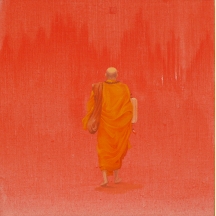
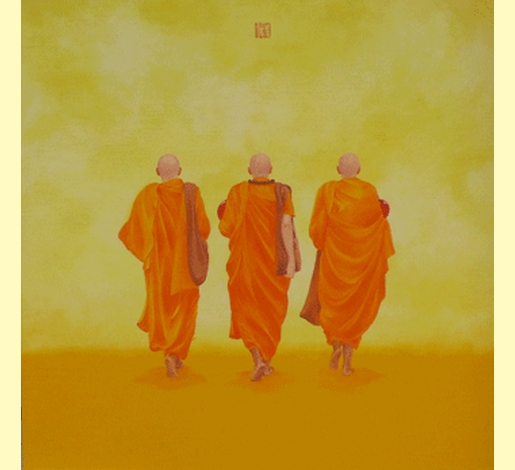
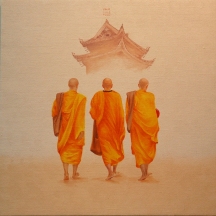
Minh Phuoc is a Vietnamese painter, born in Hanoi in 1973, a graduate of the Hanoi Fine Art Institute. His subject is almost always the same: a monk, or a group of monks, seen from the back, walking. The backgrounds change — pagoda roofs, tree tops, a deep hue of reddish orange — but they are flat and simple, and their simplicity throws every fold of the robes into focus. The gallery’s own text described the figures as travelling onwards in a purposeful journey, in a search for fulfilment.
Purposeful journey. Search for fulfilment. Both phrases struck me, and neither of them is mine.
Swami Dayananda Saraswati sets out the human ends this way. All human purposefulness falls under four headings, collectively the puruṣārthas: dharma, artha, kāma, mokṣa. And mokṣa — liberation — is freedom from the hands of time. Freedom from change, age, death, grief and loss. Escape from a never-ending sense of inadequacy, from every form of limitation. It is the desire to be rid of desire itself.
Every human seeking is basically a search for liberation. But most people look where liberation is not available. They have not singled out freedom itself as the end, so they keep their sights on a house, a job, a marriage, a holiday — whatever stands in for completeness at the time.
Some among them do single it out, usually after discovering that achievement does not satisfy for long. And then the search changes shape. It becomes a search for the means, and it can take a seeker across a great deal of ground — from yoga to therapy, from guru to guru — in a long process of negation until the goal takes definition and the means becomes clear.
Why is knowledge the only means? Because what is being sought is limitlessness, and limitlessness cannot be produced. It either is or it is not. It can never be the end product of a process of becoming; an endless series of limited things does not add up to the limitless. If freedom is already an accomplished fact, then my failure to see it can only be ignorance — and if the problem is ignorance, the search for liberation becomes a search for the knowledge that removes it.
That maturing has two names. The desire for freedom is mumukṣutva. When it has matured into a desire to know, it is jijñāsā.
Now look at the paintings again, and at the order they hang in.
In the first two, the monks are walking towards something not yet visible. That is the initial desire for freedom. In the second two they are walking towards a monastery — a seat of learning, the place where the one who embodies the knowledge lives. That is the recognition that only knowledge sets you free.
And across all of them there is the same purposefulness in the stride. That intensity is mumukṣutva.
Three terms that take a chapter to define, understood instead by looking at four paintings in the right order.
Deng Chengwen’s blindfolded walkers
The seeker has an opposite, and I found him in Beijing.
Deng Chengwen paints a series called Blind Walking. Crowds of people, blindfolded — but blindfolded by each other’s hands — pressing forward on the tops of buildings, at the edges of cliffs, along speeding highways, across trackless desert.
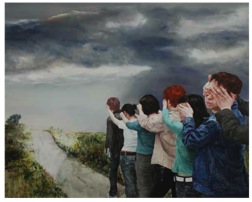
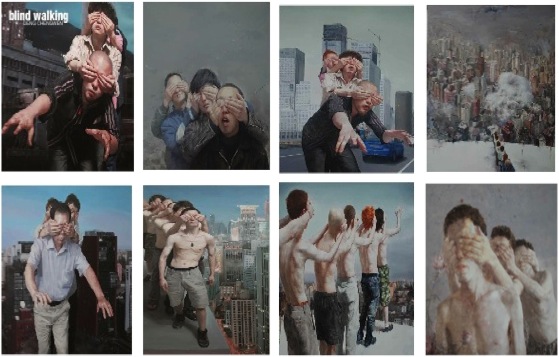
The critic Wang Huaxiang wrote about them better than I can:
You poor people! Crowding around and pushing forward, you seem to draw only to the unknown — walking on the top of buildings, at the edge of a cliff, on the speeding driveway and in the trackless desert, always in danger. Blindfolded by each other. You never attempt to pry away the hand that covers your eyes.
Deng Chengwen places these blind walkers in various settings, repeatedly pointing to their ignorance, whether in the city or in the wild. The artist has no intention of removing their hands from their eyes, nor does he intend to bring them out of these dangerous settings, because he is aware that this cannot change unless the blind walker himself is willing to change.
That last clause is the whole of adhikāritva. The teaching is available. It changes nothing until the student is ready.
I wrote to the artist through his gallery and asked what he had in mind. He replied in Chinese and then translated it himself:
With the rapid progress of these modern times, we have come to believe we have become more refined and cultured, when in fact we may be moving backwards. We thought we had developed a network that broadened our horizons, letting us take in a wealth of information without leaving home; perhaps the network has made us more blind. We assume that living in the material world means we are prosperous and have grown wealthier; we may be poorer. We believe that what our eyes see constitutes the world, and is what we know of the world. Day after day we thought that “life” is life, that “great” is great, “small” is small, that “beauty” is beautiful and “ugly” is ugly, that “good” is good and “evil” is evil, and that the “reality” of the story is the truth.
Perhaps we are all blind animals, walking on.
He had arrived, by himself, in a studio in Beijing, at Yama’s answer to Nachiketa.
avidyāyām antare vartamānāḥ, svayaṁ dhīrāḥ paṇḍitam manyamānāḥ dandramyamāṇāḥ pariyanti mūḍhāḥ, andhenaiva nīyamānā yathāndhāḥ
People sunk in ignorance, considering themselves great heroes and well-learned, understanding everything, are like blind men led by one who is blind himself. They run hither and thither, finding not what they seek.
— Kaṭha Upaniṣad 1.2.5
Swami Krishnananda’s commentary presses harder than the verse:
People run here and there for happiness because of their desires, and find it nowhere. They are misguided, and it is unfortunate that there is no one who can see things as they are. Everyone is on the same level of learning. Not only this: the blind thinks that he sees, the ignorant thinks that he is learned. Learning itself becomes a form of ignorance, just as our happiness is itself ignorance, because we think we are happy when we come into contact with sense-objects.
The image travels. From Yama to Nachiketa in the Kaṭha Upaniṣad; to Jesus in Matthew and Luke — if a blind man leads a blind man, both will fall into a pit; to a Chinese painter in the twenty-first century, who had read neither.
In my own blind passion for finding Advaita in art, I could see one piece of wisdom moving across eras and countries, taking different forms and conveying the same thing.
It is also, I suspect, the oldest recorded case of appropriation without acknowledgement.
III. The Witness
Antony Gormley’s four fields
Sākṣī, the witness, is one of the central terms in Advaita. Before going to the texts, look at four installations placed in four parts of the world by one man. Three of them Gormley acknowledges as a series. I have added the fourth because the theme is the same.
Inside Australia. Fifty-one life-size figures spread across seven square kilometres of Lake Ballard, a salt lake in Western Australia. Body scans of the local people, transformed into abstract figures in black steel. At sunrise and sunset the shadows of their limbs fall across brilliant white salt.
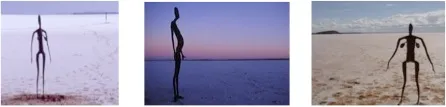
The works are positioned about 750 metres apart; wherever you stand within the field of the work there are tiny, hair-like verticals hanging from the horizon. Viewed in the heat and sharp light, they constantly draw you to the edge of your perceptual field. As people move across the work they leave a tracery of connecting lines between the figures across the sharp whiteness of the lake. This is a sign of the viewer’s participation in a work which changes, as does the sky, throughout each interval of the year.
Another Place. A hundred cast-iron figures moulded from the artist’s own body, along three kilometres of Crosby Beach. All facing the same way, in the same pose, sparse in some stretches and gathered towards the sea. The tide decides how much of them you can see. At low water, all of them. As the water rises they are visible from the waist. At high tide they are gone.
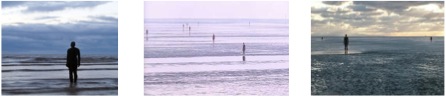
A whispering communication with forgotten levels of history. A kind of acupuncture of the landscape, but also an acupuncture of people’s dream world.
Each person is making it again. For some it might be about human evolution; for others it will be about death, and where we go, where our bodies finally belong — do they belong to the earth and the elements?
Event Horizon. Thirty-one figures on the pavements of Madison Square Park and on the rooftops of Manhattan, including the Empire State Building.
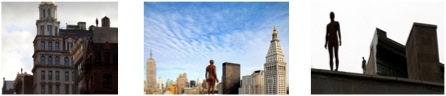
You could almost say the insertion of the sculpture is like the insertion of acupuncture needles within a collective body, and seeing how the body as a whole reacts to the presence of this irritation is very much the point. It has to do with questioning both the status of art and the nature of our built environment. In a time of rising environmental awareness it asks the question: where does the human being fit into the scheme of things?
Horizon Field. A hundred figures across a hundred and fifty square kilometres of Vorarlberg, standing on one horizontal line two thousand and thirty-nine metres above sea level, at intervals from sixty metres to several kilometres depending on the terrain.

We’ve done the sea, New York, and now the mountains. We’ve covered the urban condition, the endlessness of the sea, and now the chaos of the mountains.
He calls the figures silent witnesses — his phrase, not mine — and says they are neither representations nor symbols, but define the place where a human being once was and where any human being could be.
Now the text. The witness appears throughout the Upaniṣads, but for these four works I want Lakṣmīdhara’s Advaita Makaranda, verse 13:
sadvikāravatāṁ vettā nirvikāro’ham anyathā tadvikārānusandhānaṁ sarvathā nāvakalpate
I am the knower — the witness — of things that undergo the sixfold modification. I myself have no modifications. Were I changeful, my witnessing of their modifications would not be possible at all.
Swami Tattvavidananda Saraswati on the verse:
The topic is the changeful versus the changeless. In your life, here and now, there is both. If you remember your life as far back as you can, you probably see yourself on your mother’s lap; now you are middle-aged. The body is overhauled every seven years, but I am is the same. The sense organs and the organs of action are changeful. The mind changes by the minute. The intellect is ever changing. When everything is changing, there must be something changeless to know the changes. I am that changeless.
My being the witness of all that changes is proof enough that I am the changeless, because all change happens against a changeless background. The track must remain still for the train to move.
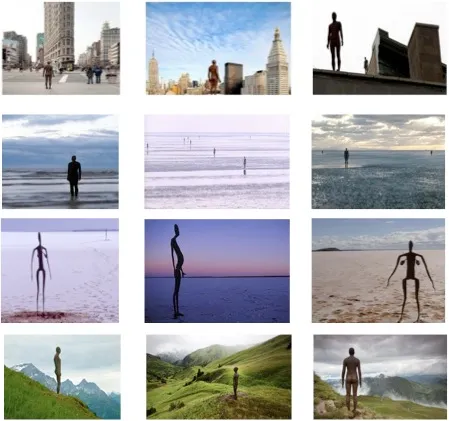
I have rearranged the four. The one in the city, apart from the three among the elements — earth, water, air. The same witnessing figures, and a completely different feeling in each place. The ones in New York make you think of what you are not. The ones in the landscape make you aware of what you are.
Gormley said Event Horizon celebrates the spirit of New York. I did not see celebration. It opened two years after the financial crisis, and what I saw was figures standing over the ruins of desire — watching, from the epicentre of the pursuit of wealth, the impermanence of both the object and the mind that wanted it. Wealth goes. Experience goes. I am remains.
The other three are doing something else. Away from the city, among the elements, they are contemplating the I am itself. If the figures on the Manhattan rooftops are householders, these are in vānaprastha, or further.
And what is left for them to witness? They have taken in the beauty of the place. Day becomes night. The tide rises and recedes. The seasons turn. The figures stay exactly where they are, as they are.
What was taken to be changeless and real — the world — is seen to be changing. What was taken to be transient — the self — is seen to be changeless. Adhyāsa is removed.
With due apologies to Descartes: I witness, therefore I am.
The stream that is not a stream
I once tried to write about consciousness in the manner of Joyce.
Stream of consciousness is a narrative device meant to depict the multitude of thoughts and feelings passing through a mind — interior monologue, characterised by associative leaps and by the absence of punctuation. William James coined the phrase in The Principles of Psychology. Joyce made it famous.
It struck me that it would be a fine way to write about consciousness itself, and I set out to do it. I researched for a while, thought I was ready, and began.
I was not ready. Two paragraphs in it became clear that I was woefully inadequate on the subject, and I did what any honest amateur does: I found someone who was not. I took Swami Dayananda Saraswati’s exposition on consciousness and removed the punctuation from it.
consciousness is awareness for example consciousness means you are conscious of something it is opposed to inertness or non consciousness it is consciousness that is manifest in all forms of perception in all forms of knowing consciousness is qualified by different objects when i say i am conscious of the pot there is pot consciousness when i say i am conscious of the cloth there is cloth consciousness whenever you are conscious of something that something becomes the qualifier for consciousness the basis for all forms of knowledge in fact both the subject and the object are consciousness but in the beginning to help you find out what you are i generally say that a thought is an object and you are the subject then when you ask what is this i that is the subject i reply you the subject are a witness and what is the nature of the witness consciousness the witness then is consciousness and the witnessed object cannot be away from consciousness therefore the witness and witnessed are both consciousness even when the witness is not there consciousness remains
I present the borrowing as it happened, because the failure turned out to be the finding.
I had set out to use a technique called stream of consciousness in order to explain what consciousness is — only to realise that consciousness, being indivisible, can never be a stream. Which makes the term itself a contradiction.
The method broke on the subject. That is the most useful thing that has happened to me in eleven years of writing these.
IV. The Sheaths
Weightlessness
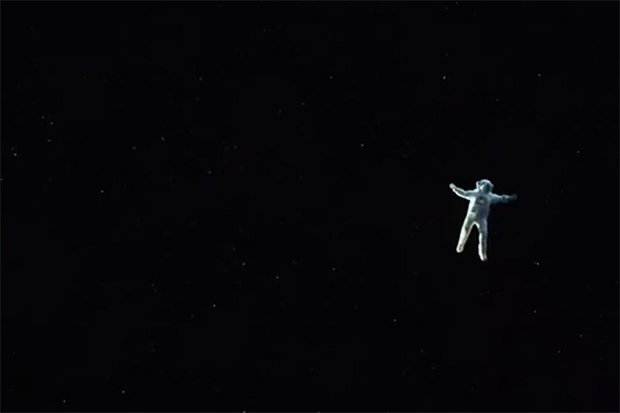
Alfonso Cuarón’s Gravity is a film that stays with you. It depicts a world without oxygen and arrives like a breath of air. The soundtrack lets you hear the sound of silence in space. The photography gives you infinity through a contrast of man, earth and void. The camera pulls you in alongside the protagonist and makes you experience weightlessness. Along with her, you are lost in the vastness, searching for the limits of the limitless.
Watch it. Prepare to be immersed. There will be stretches where there is no seer and nothing seen.
The teaching method of Vedanta is negation — neti neti, not this, not this — used to establish what you actually are. One of its instruments is pañca-kośa, the five sheaths. Sivananda:
Out of delusion and ignorance, man identifies himself with the five kośas — annamaya, prāṇamaya, manomaya, vijñānamaya, ānandamaya — and thinks that he is subject to all their changes. He identifies with the annamaya kośa, the physical body, and when the body burns he thinks himself burnt. He identifies with the prāṇamaya kośa and thinks, I am hungry, I am thirsty, I did this action. He identifies with the manomaya kośa and thinks, I am angry, I am lustful, I am greedy. He identifies with the vijñānamaya kośa and thinks, I am intelligent, I know everything. He identifies with the ānandamaya kośa and feels, I am happy. Not one of them is the Self.
Just as there is a set of five vessels, one inside the other, or the layers of an onion, these sheaths lie one within the other. There is the singlet next to the body; over it the shirt; over the shirt the waistcoat; over that the coat; over that the overcoat. So too is the Ātman enveloped.
Through discrimination between the real and the unreal, a man abandons the first sheath and recedes to the one behind it, resolving each into what lies behind, until he reaches the innermost and holds to that alone.
Now: Kalpana Chawla.
She was the first Indian woman in space. On her first mission in 1997 she logged more than three hundred and seventy hours, travelled ten million miles and completed two hundred and fifty-two orbits. She died on her second mission, in 2003. In an interview after the first flight, a reporter asked her what the strangest thing about zero gravity was.
One of the strangest things is that when I was about to sleep, I realised I was only aware of my thoughts. Because you are weightless you don’t feel your legs or your body. In a sense then, you are just your intelligence. It’s amazing — you can’t feel anything but your consciousness.
I first read that in 1998 and did not give it much weight. In 2003, when she was killed, I went back to it with more attention, because by then I had begun to study Vedanta, and I remember telling a friend that she had probably arrived at it because of her Indian background.
It was in 2013, watching Gravity and experiencing weightlessness at second hand, that what she said finally landed.
You are just your intelligence. You can’t feel anything but your consciousness.
Weightless, she had unpeeled three sheaths — annamaya, prāṇamaya, manomaya. She was halfway through pañca-kośa and had never heard the term.
I read her biography afterwards. Her husband read the Gita; she read Ayn Rand. There is nothing in her background to suggest she would arrive at that. Which is the point, and it cuts against me rather than for me: her account carried no prior knowledge of Vedanta, and mine would have. If I had been in her seat and someone had asked me how it felt, I would probably have said aham brahmāsmi, and it would have been worth nothing.
Two cautions, both necessary. Vedanta is not about an experience; it is about the removal of ignorance through knowledge. Pañca-kośa is not something to feel. It is something to understand.
And yet. If weightlessness can make a person discover that she is only her intelligence, it may be worth building an antigravity chamber in which students of Vedanta can sit with the teaching of the five sheaths. No distance is too long to travel, if the destination is the ātman.
A room on a roof in Mayfair
8 September 2014, Mayfair, London.
On a flight to London I read about a new work by Antony Gormley at the Beaumont Hotel, and with a few hours spare I went to see it. The form is familiar from his other works. Two things are not. It sits on top of a building. And it is a bedroom.
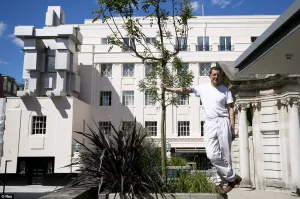
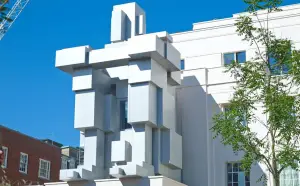
Walking up the alley, there it was: a crouching metal man hugging his knees, assembled from cubes, jutting out from one side of the building with his head at the roofline. There is no square in front of it, so you cannot stand back. You crane your neck at an imposing figure that refuses to look back at you and gazes ahead, indifferent to everything around it.
The hotel had not opened. Construction workers were still going in and out. I took photographs from every angle I could find, and then I walked up to the security desk and asked to see the owners.
I was armed with a photograph of Antony and me taken in 2012, when I met him at TED Global, and I thought I could charm my way in. The guard was unimpressed but made a half-hearted attempt to look for the owners, and after some conversation over the radio the head concierge came out. I gave him the same speech — how great an admirer I was — showed him the photograph again, and murmured that Antony was an acquaintance.
I could not bring myself to say friend.
The concierge was very polite. Guests would be paying two and a half thousand pounds a night once the hotel opened; it would be unfair to them to let a non-paying visitor in. He added, helpfully, that because the room is a work of art in public use, the law requires it to be open free for two days a year, and that I should come back on the twentieth. When I told him I would be gone by then, he stood with me and described the interior in detail until I had run out of questions.
Then I stood there a while longer, looking up at the work of a contemporary genius that I was not going to be allowed inside.
The room. The living room and bathroom are in the hotel; the sculpture houses only the bed. You enter from a white marble bathroom — the idea being that you sleep in the nude — through a doorway hung with heavy drapes to keep the light out. A short flight of stairs leads to a landing with a bed on it and nothing else. No furniture. The whole space, ceiling included, is panelled in burnt dark wood. One small shuttered window faces the bed. Lying down, you look up into a height of thirty-three metres. Small lights are set behind the headboard and in the panelling, enough to let you make out the contours of the body from the inside.
Gormley on the work:
I conceived of the room as a hermit’s cave; a primal space within the city but removed from the city entirely.
What I’ve tried to do is bring that space you experience when you close your eyes, and real space, somehow closer together.
Luxury is a sense of total peace, silence, and a place removed from the incessant demands of the world.
It’s a cave, a tomb, a womb or a padded cell. I hope it will provoke its guests to ask themselves such existential questions as: who am I and what am I doing here?
I take the body as our primary habitat. ROOM contrasts a visible exterior formed from large rectangular masses with an inner experience.
Shutters over the window provide total blackout, and very subliminal levels of light allow me to sculpt darkness itself.
My ambition for this work is that it should confront the monumental with the most personal, intimate experience.
It is well known that Gormley spent two years in India in his formative years and practised Vipassana, and that his choice of the human form came partly from watching people lying on railway platforms here.
Reflecting on the room, I remembered his TED talk from 2012, and his account of being sent upstairs after lunch as a six-year-old for an enforced rest in a tiny hot converted balcony room — and how, after days and weeks and months of promising himself he would not move, the space behind his eyes got bigger and darker and cooler, until he began to look forward to that half hour, and to going to that place of darkness.
I have read every interview he gave at the launch and none of them mentions it. So this is strictly my deduction.
And now, since I could not afford the two and a half thousand pounds, the easier option: what I would reflect on if I ever did spend a night in it.
Lying on the bed — one hopes the mattress is soft — I would take in the sculpted darkness, and as my eyes adjusted to the contours of a human form seen from the inside, I would meditate on the pañca-kośa. Unpeeling, as it were, the five sheaths that make up the gross, subtle and causal bodies.
He made a cave out of a body and asked his guests who they are. I would take him at his word.
There is no better place than being inside a body, to discover you are not one.
V. Superimposition, and Its Removal
An evaporating self
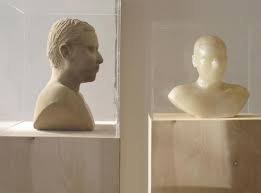
Alwar Balasubramaniam is an Indian sculptor whose work is deeply philosophical, much of it concerned with origins and traces. The piece of his I keep returning to is Evaporating Self: a bust of himself made from the material used in air fresheners. Given what it is made of, the seemingly solid head disintegrates. Over a few months you can watch it evaporate in front of you. Form to formlessness, at a speed slow enough to sit with.
The goal of Vedanta is to remove the false identification with the body and establish you as ātman, pure consciousness. Through a systematic unfolding of the śāstra, you move from being a body that has consciousness to being consciousness that has a temporary body. Someone firmly established in that understanding is said to be liberated.
The process has three stages. Śravaṇam: listening to your teacher unfold the scriptural knowledge. Mananam: reflecting on it and raising your doubts, to yourself and to your teacher, until you are intellectually satisfied. Nididhyāsanam: contemplating it until it becomes part of your being.
The Upaniṣads are full of fables that serve the middle stage. I have always found art to serve it too.
Listening to Balasubramaniam, I could easily see my own bust made of the same material, enclosed in a box, disintegrating slowly until nothing was left but the space inside the box. Consciousness cannot be described, being beyond the senses; space and light are the two things the tradition uses as pointers to it.
So the next time you are sitting on the pot, look at the air freshener and construct a bust of yourself from it. Watch it evaporate. Identify with the space it leaves. And do not get so disengaged from yourself that you walk out without your clothes, as Archimedes did.
You are consciousness. The body is temporary. It is a serious teaching and there is no reason it cannot be delivered in a bathroom.
The rope and the snake, printed frame by frame
If you have not seen Christopher Nolan’s Memento, stop and watch it.
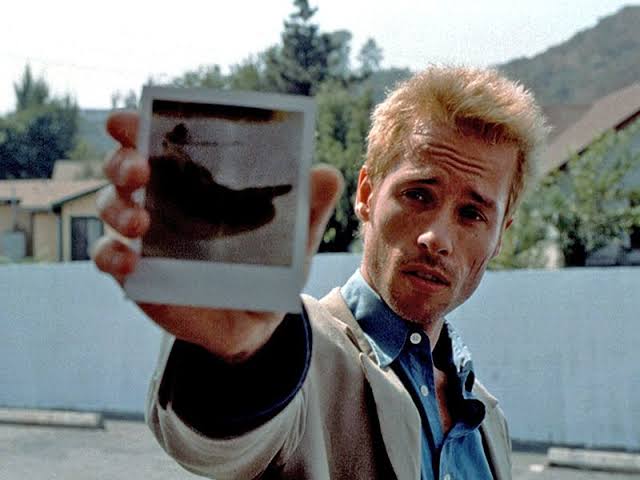
Its narrative structure is among the most original in the history of film. The protagonist has anterograde amnesia: he cannot form new memories. The story is told in two tracks at once — a black-and-white track running forward in chronological order, and a colour track running backwards — and the two meet at the climax. Notes, photographs and tattoos are all he has to hold the story together.
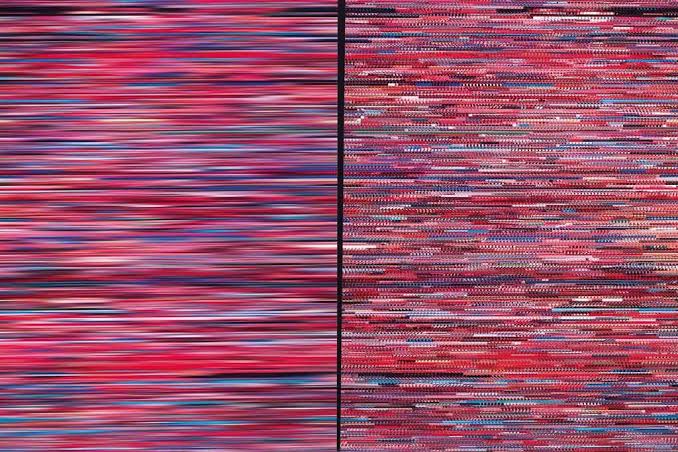
Wang Guofeng is an artist in Beijing. I was introduced to his work at Art Stage Singapore in 2014. His Memory series consists of large panels of blurred and streaky lines; look closely and each line turns out to be a print of a film, captured frame by frame, so that you can follow the story scene by scene like a storyboard. Wang holds that memory is subjective and selective, and he uses the series to ask whether human recollection of history is reliable. He does not think it is. He thinks lapses are normal, that they make our history abstract, vague or over-beautified, and that we are therefore destined to repeat what we cannot accurately remember.
In Advaita, the rope and the snake explain māyā. In dim light a man takes a rope for a snake; in daylight he sees it is a rope. He has recalled the attributes of a snake from memory and superimposed them on what is in front of him. This is what we do with the body and the world — take them for real — until knowledge, or light, or a correct understanding of the ultimate reality removes the error.
I like art that has a philosophical basis under it, and I tend to lay my own Vedantic concepts over a work. The artist may never have considered them. Through that layering I make the work mine.
I walked around the rest of the exhibition and kept being pulled back to Wang’s panels. Memento was in my head, and so was the rope and the snake, and then I saw two panels.
One black and white, one colour. Both carrying frame-by-frame images of the film — the black-and-white panel the section that runs forward, the colour panel the section that runs backward. And by printing certain areas lighter and darker, a subtle image of a rope on one panel and a snake on the other. A multi-layered work about memory, made out of Wang’s own method.
I took the artist’s address and reached out. My nephew was living in Shanghai, and I asked him to go to Beijing and visit him. Wang and I then spoke over Skype and I explained the idea. He was happy to make it. I asked for two versions, because I wanted to give one to Nolan.
Wang was keen. The gallery that represents him was not; customised work outside his usual body of work was a problem for them. A curator friend advised me that a piece like this would have no resale value and would therefore have to be priced differently, and the gallery would not yield. I also had no rights to the frames of Memento.
Eventually I dropped it.
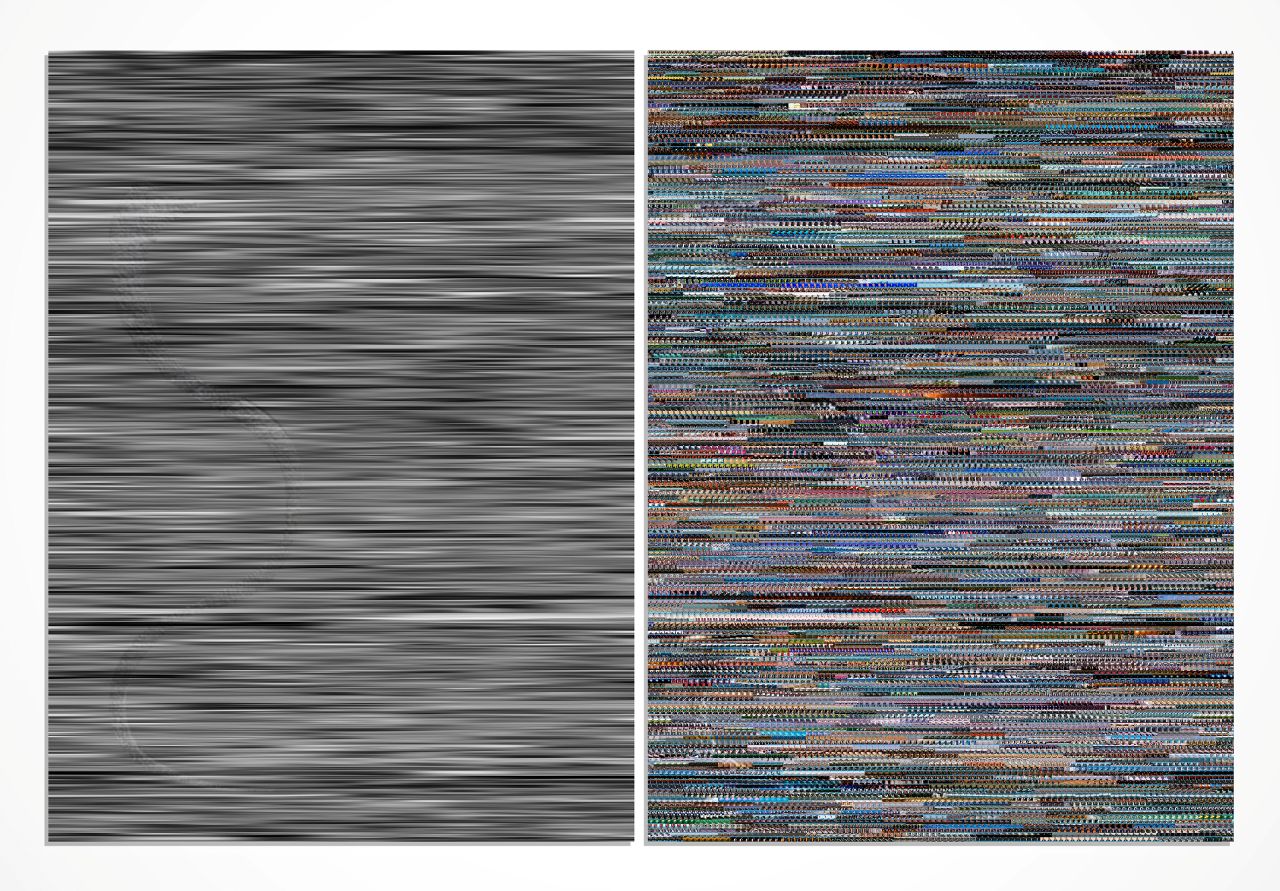
What is left is a Photoshop mock-up made to explain the idea, in which you can see the snake and the rope very faintly.
Writing this now, to capture the memory of a memento on memories, made for Nolan, that did not materialise and remained illusory.
The last mirror
Aparna Rao is a Bangalore-based artist and a TED Fellow, known for playful, high-technology installations. She works with Søren Pors, and the two of them build things that are funny and interactive and quietly unsettling. I first met her at TED Global in Edinburgh around 2012, and we have stayed in touch. It has been a pleasure to watch her work grow.
My favourite piece of theirs is Someone’s Coming, shown at the Setouchi Triennale in 2016. A maze-like gallery hung with blank canvases that peek around corners as you come in. Restlessness and anticipation, made out of nothing but timing and attention. Playful, and not.
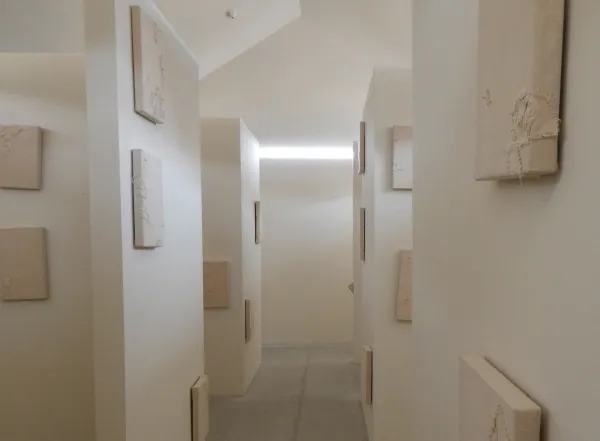
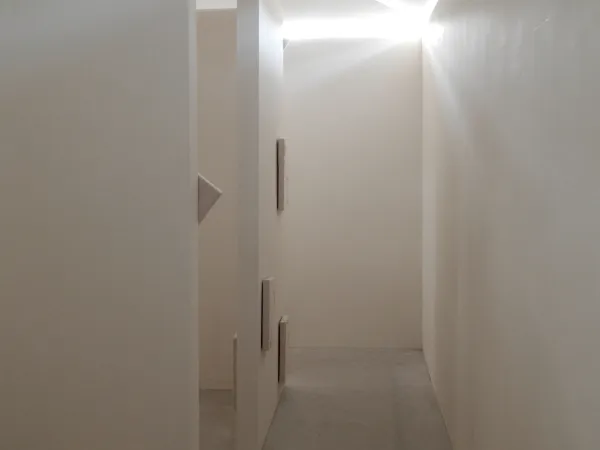
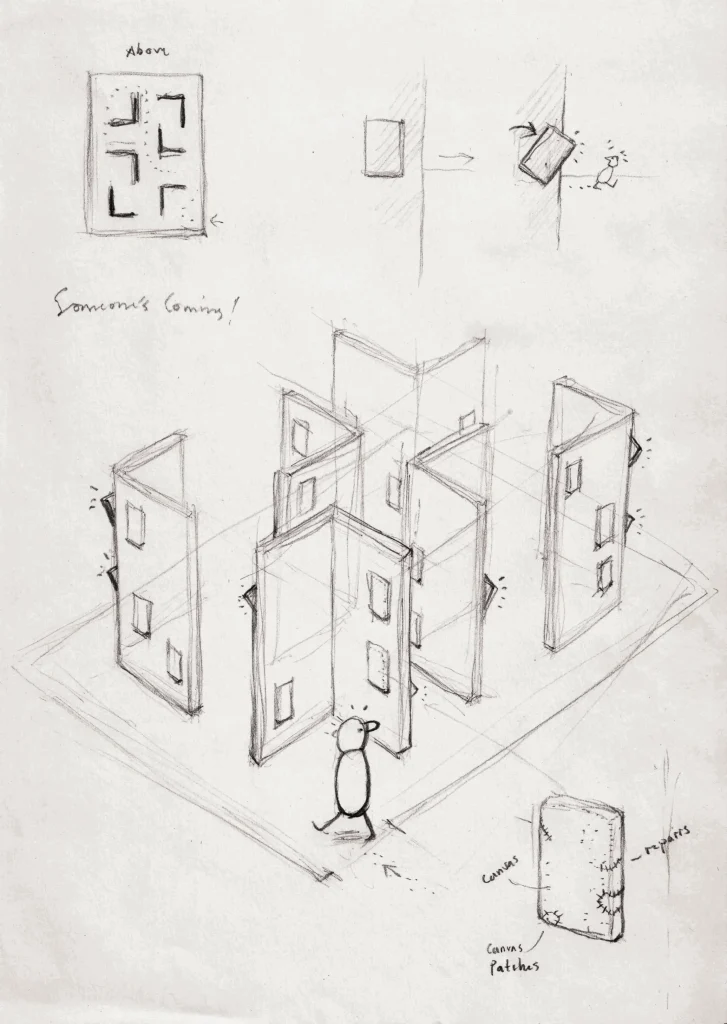
Aparna sent me the link, and I could not help looking at it through the Vedantic lens.
Pratibimbavāda holds that the individual self is a reflection of the ultimate reality, as a face is reflected in a mirror. I saw a version of her installation that would teach it.
Replace the canvases with mirrors.
As you walk through the space, the mirrors respond to your presence — and like her canvases, they hold still when you face them directly. The self cannot be objectified. It withdraws from being looked at.
The mirrors begin very clouded and grow clearer as you proceed along the path. That is avidyā being removed, gradually, in the only order it can be removed in. The second-to-last mirror is the clearest of all; there you see yourself plainly, and recognise the self as a reflection of Brahman.
And the final mirror is a trick mirror. Perfectly clear, and it does not reflect you at all.
Because Brahman is formless and without attributes, and cannot be captured or made an object. Because the true self is the subject. Because the whole walk was an adhyāropa, and the last mirror is the apavāda.
I have not built it. I am setting it down because a described work is still a work, and because this is the one place in eleven years where the procedure completed itself without my planning it: superimposition, walked through in sequence, and then withdrawn.
VI. Form and Formlessness
Quantum Cloud
brahma satyaṁ jagat mithyā, jīvo brahmaiva nāparaḥ
Brahman alone is real; the world is not; and there is ultimately no difference between Brahman and the individual self.
Adi Shankara’s statement carries the whole of Advaita in one line. Antony Gormley’s Quantum Cloud, standing in the Thames at Greenwich, is a physical and artistic expression of it. Here is how.
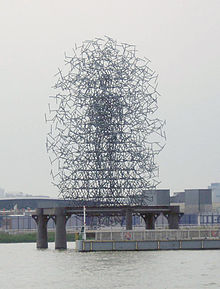
Brahma satyam. Consciousness cannot be described. We tend nonetheless to picture it as a grey or black mass of uniformly random matter, ever moving. The cloud — generated, as it happens, by random-walk software — represents pure consciousness precisely because it was built to give a simultaneous feeling of form and formlessness. And satyam here means that which transcends time, beyond past, present and future. If you had to represent that in a man-made material, steel would be the right one: not only for its texture and strength but for its durability, its refusal to go.
Jagat mithyā. The illusory nature of the world is in the haze of the steel, and in the fact that the cloud has no definite shape. The frayed edges, and the elliptical rather than spherical mass, give the feeling of something changing while you look at it.
Jīvo brahmaiva nāparaḥ. The human form emerges from within the cloud, made of the same elements as the cloud. Man and consciousness are not two. And the non-difference is in your inability to see where the human figure begins or ends. Look long enough and you cannot say whether the figure is emerging from the cloud or the cloud from the figure.

The first logo of Advaita Academy came out of this sculpture.
A grey painting
I came across the Chinese painter Minyiyao some years ago, and one painting of his has stayed with me.
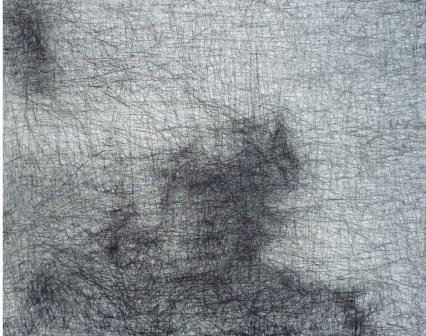
His gallery text says that in his work the technique draws the viewer rather than the image; that with seemingly wild brushstrokes he manages to capture light and depth; that the random play of strokes unwittingly forms an image thought had not defined beforehand; and that he restricts himself to a palette of exceedingly dreary colours, which is what makes the technique visible.
The austerity of grey and the use of a single colour are the first things that hold you. Then, looking closer, you see a form emerging from what appear to be random strokes. My first assumption was that the form was a smudge laid over lighter lines. It is not. The lines that make the form are not distinct at all; they are a continuum of the scribbles around it. The artist has simply pressed harder at certain points and then continued, without a break, into a lighter mode. The result is quite literally a maze, and it takes a while before you realise, all at once, that you are looking at a human head.
For me it did not stop there. It was not a puzzle to be solved and left. It was the simultaneous depiction of form and formlessness. Of the ultimate reality and the individual. Of duality and non-duality at once.
Brahman is beyond description. The teaching gives us pointers only. Swami Parthasarathy lists them: one, all-pervading, formless, attribute-less, eternal, stainless, infinite, knowledge, bliss.
Several of them are in this painting. Oneness, in the single colour. Formlessness, in the aimlessness of the strokes and the haze they produce. Absence of attributes, in the refusal of every colour we normally live among, and the use of grey instead. Infinity, in the fact that you cannot find where any line ends. And the upturned head, in something like bliss.
A picture is worth a thousand words. The indescribability of Brahman remains what it is — but sometimes a painting makes it very much easier to hold.
VII. Wave and Ocean
Storm King, and a wall of names
I love sculpture. The three-dimensionality; the range of materials; the possibility of working at a scale beyond a room or a building; the freedom from four walls; the chance to meet a work at any hour of the day or night, and in unexpected places; the way the elements become part of the work. Nothing else attracts me in the same way.
To me a sculpture is energy in motion frozen in time, captured by the artist as a snapshot.
I love sculpture parks for the same reasons. Walking in the open, away from the crowds of galleries and museums, alone with a work, seems to do more justice to what the artist put in. Art is best enjoyed in solitude, and a sculpture park is where solitude is possible. There you can listen to the artist, and not merely look at the work.
And there are sculpture parks, and there is Storm King. Five hundred acres of hills, fields and woods in the lower Hudson Valley, with more than a hundred sculptures in them. Everything is monumental — the works, the landscape, the mountains behind. Each piece is sited so that arriving at it is part of it. Nothing I had seen before prepared me.
- I was a nineteen-year-old undergraduate. I had read and reread The Fountainhead, Howard Roark was my hero, and I had briefly considered architecture before choosing commerce. I came across an article about Maya Lin and the Vietnam Veterans Memorial. That she had won that competition while still an undergraduate was inspiring in itself. But the simplicity of her idea — inscribing the names of all the dead on a wall of black granite — stayed with me for a long time.
- I understood how long only fourteen years later, when N. T. Rama Rao died. There was talk immediately after the funeral of a memorial, and I found myself recalling Maya Lin and drawing a design.
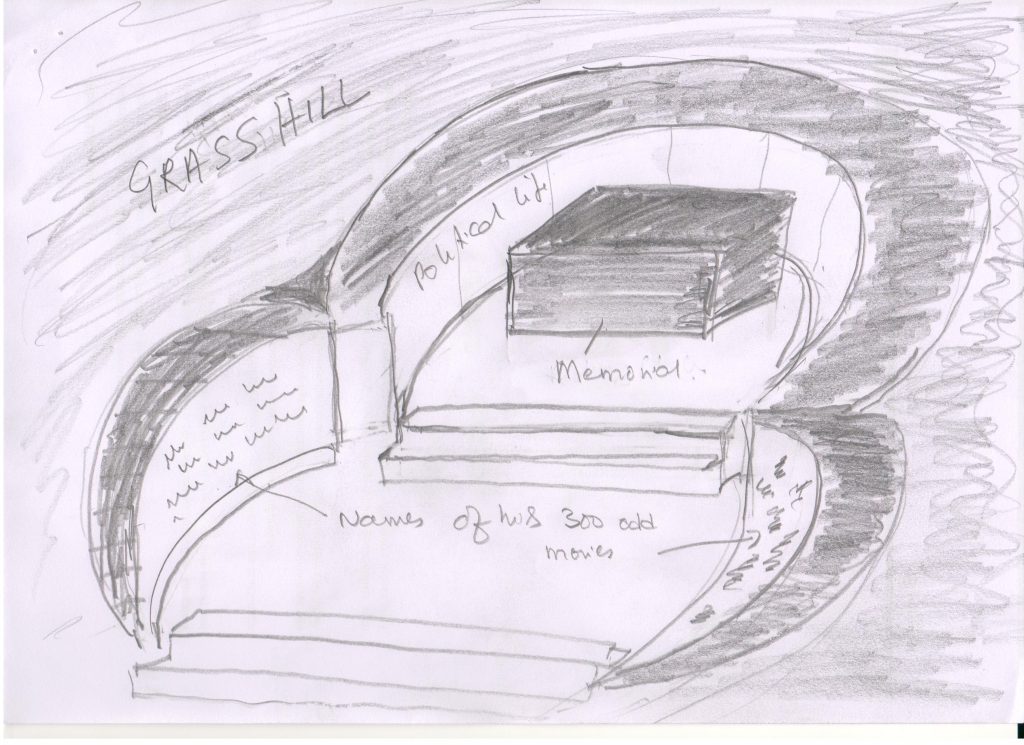
I cut it into a mound, on two levels, for the two stages of his life: one carrying the names of all his films, the other his life in politics. The idea was that as people read the titles of the films, they would relive each one and the part he played in it, in their own minds.
I was not qualified to submit a proposal, and the government never asked the public for any. So ended my career as a memorial designer, before it began.
17 October 2013. Nora Lawrence, associate curator, was driving me around Storm King in a buggy. Near the top of a hill she slowed and said we were about to see Maya Lin’s Wave Field. I let out a shout, jumped out before the buggy had stopped, and ran to the edge of the slope.
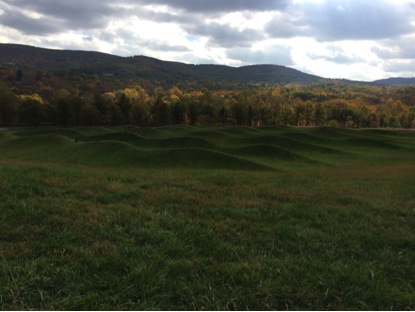
I stood there and watched the undulations of earth and grass against the mountains behind. Of the hundred-odd works in the park, this is the only one made of nothing but earth.
From the height I was standing at, the waves of earth looked like an extension of the mountains themselves — both made of the same material. And the analogy arrived before I could stop it. Dennis Waite, in The Book of One:
Ishvara is everywhere, in and through everything. So everything can be regarded as a form of Ishvara, in the way that a wave is a form of the water constituting the ocean. Ishvara is the sum total of all things, in the way that the ocean is the sum total of all waves, representing the macrocosm, whereas the individual wave, the jīva, is the microcosm.
Instead of water, ocean and waves, I had earth, mountains and the Wave Field. The mountains as the macrocosm. The waves as the individual.
I asked Nora for a few minutes, and used them on a verse of Shankara’s, in which even the liberated man insists on devotion:
Oh Lord, though I am aware of the non-difference between you and me, I still wish to say that I belong to you. A wave is said to belong to the ocean; the ocean is not said to belong to the wave.
As we drove down the hill, Nora asked whether I would like to walk through the Wave Field and have the experience the artist intended — moving among the waves.
I declined. What had happened had become something close to a sacred experience, and I did not want to disturb it by walking over it. We went on to the next sculpture.
It was only afterwards that the artist’s first name caught up with me. Maya. Illusion.
Storm King had stopped being a sculpture park and had become a spiritual one.
Three pictures of a crowd
Unity can never be experienced.
If the experiencer and the experienced become one, there is no experiencer left to experience the oneness. Every account of oneness is therefore a pointer and can never be a description. You can set out from multiplicity towards unity, but you will never remember arriving.
Teasingly near. Tantalisingly close. And then.
The first of the three came as a gift. A former colleague posted a painting on her Facebook page and I wanted it immediately, with the directness of a child asking for chocolate. She smiled and said her cousin in New Zealand had painted it, and that she would ask him for another. On my next birthday a cardboard tube arrived from New Zealand.
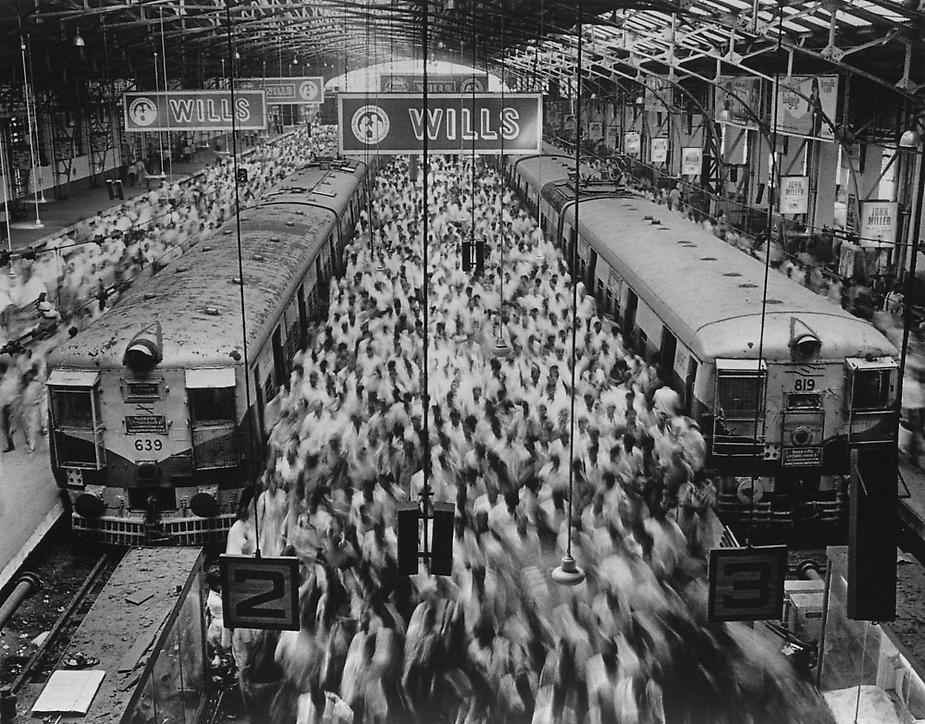
The second I found in a gallery: Sebastião Salgado’s photograph from the Migrations series, taken at Churchgate Station in Bombay in 1995. I was captivated enough that I went back the next day to spend more time with it. The gallery print was large; the versions on the internet lose everything. Amongst the sea of moving humanity there are exactly two still figures — a woman sitting on a bench on the left, and a man standing against the flow.
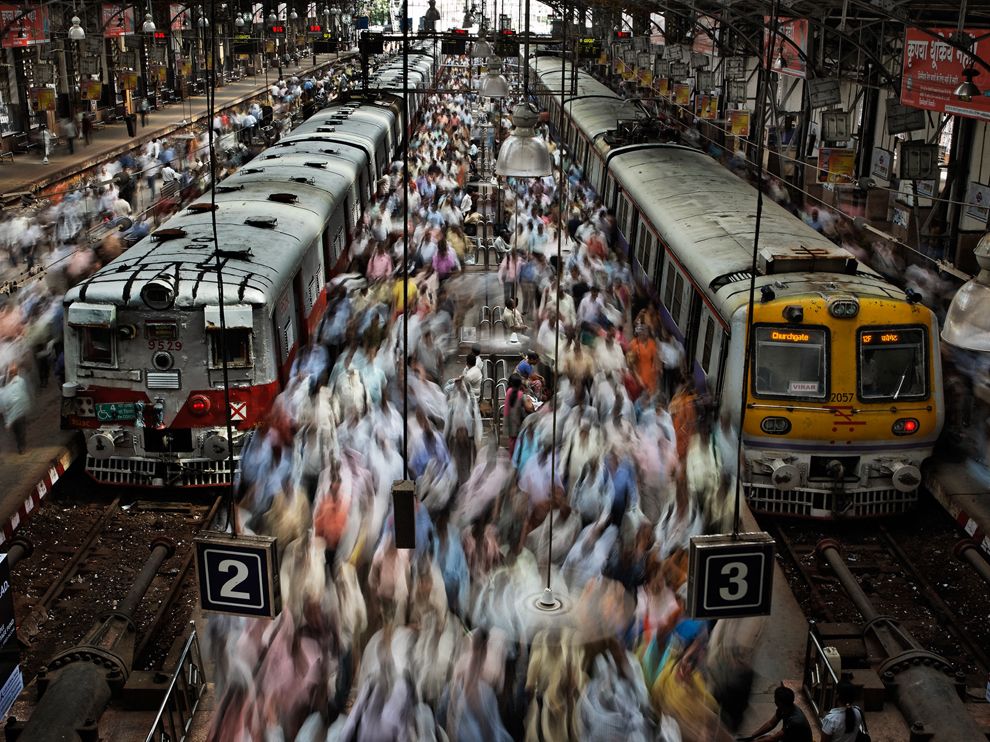
The third turned up while I was looking online for a print of the Salgado: Randy Olson’s photograph in National Geographic, framing the same view of the same station some years later, in colour, with the movement more pronounced.
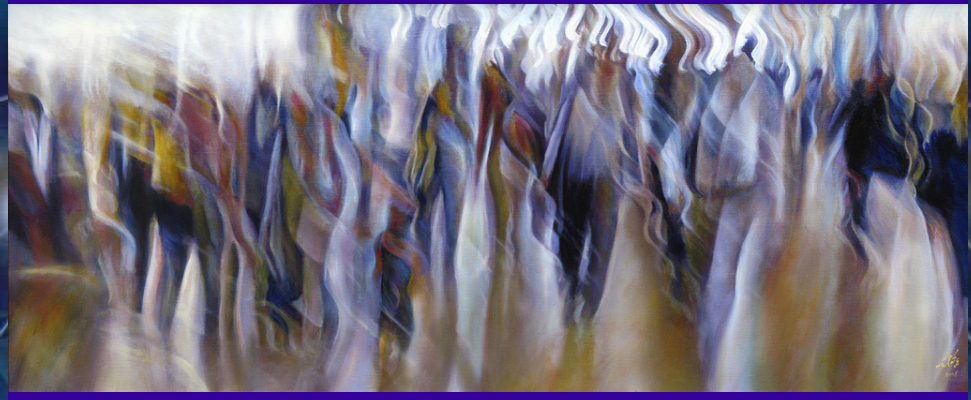
The painter is NgAngA. On his own painting he wrote:
The scene is typical of any major city railway station anywhere in the world at rush hour, the peak of the daily commute. Most of you have experienced such a scene at least once — a blur of motion and colour, as you dance through the crowd, either with or against the flow.
The painting could also be viewed metaphorically as the end of the rat race — the rigid competitive structure of mainstream society — as we move forward with the flow of community spirit and become human beings again. Seen that way, the figures represent the essential spirit of humanity, harmoniously interwoven in the shared enterprise of conscious evolution.
When I first saw it, what I saw was the moment at which multiplicity converges into unity. In that respect his intention and my reaction were the same, which is rare in these essays.
My reaction to the Salgado was similar, though the movement towards oneness there is much more subtle. The starkness of black and white, the mass of humanity converging — and then the two motionless people, which make the movement of everyone else unbearable. The trains are still and the people move. The platform and the station are precisely observed, and they quietly carry the fact of a journey.
Olson’s photograph is a stroke of luck and completes a set. The contrast between stillness and movement is gone — everyone is moving — but the movement itself is more emphatic.
NgAngA does not give you the station at all. It is assumed. The viewpoint is at eye level and all you see is the mass you are walking into, or that is walking towards you. The blur is precise. So are the occasional legs. The contrast between them holds duality and oneness open at the same time.
Take the three in sequence and you can feel the movement beginning in Salgado, gathering in Olson, and peaking in NgAngA. Assembled that way, they are a journey from multiplicity to unity.
I did not arrive. I got teasingly near.
VIII. Surrender
I have a sculpture by Ma Yue in my living room.
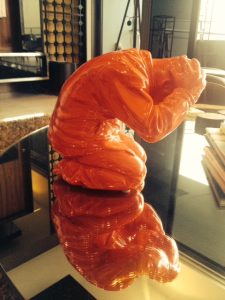
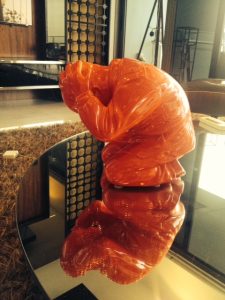
I first saw it in a gallery in 2009 and was drawn to it immediately: a helpless crouching figure, hands over his head, bent low as though expecting a blow. There was something so evocatively tragic about him that I wanted to reach out and protect him.
The same gallery was showing his Cowering series. The same figure recurs against vast expanses of a single colour — sometimes alone, sometimes with others like him, sometimes alongside Chinese political icons. Small, crouched, faceless, against something much larger. Art China put it well: he concentrates on one subject, the crouching figure, faceless and powerless, with a different background each time; the paintings are bright and energetic and carry a disturbed reality underneath.
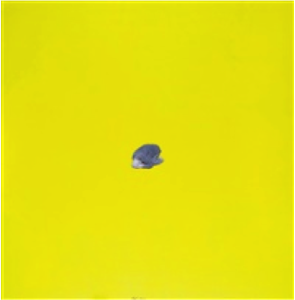
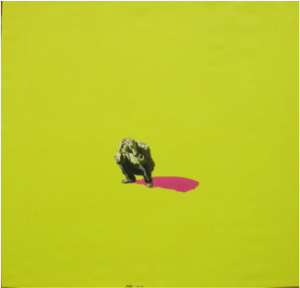
Years later I was listening to a talk by Swami Paramarthananda on how to accept choicelessness, and I have never stopped thinking about it.
His argument, compressed. The first part of the Veda deals with the ordinary problems of human life, and if you analyse them, all of them reduce to one: we are unable to accept some situation we are facing. Hatred is the inability to accept a person’s character. Anger is the inability to accept a behaviour. Jealousy is the inability to accept a neighbour’s prosperity. Fear is the inability to accept a future that has not yet arrived.
For a great many situations the tradition offers remedies. It also concedes, plainly, that for many others there are none — apariharya, that for which there is simply no remedy. And it is common sense that what cannot be cured must be endured.
And here is where the difficulty actually sits. We know we have to accept. We know every door is closed. The intellect has understood it completely. And the mind refuses.
A man arranges for his own daughter to study abroad, and then weeps when she goes. Ask him why and he agrees he should not weep. He weeps anyway. No argument you can construct has any effect. The intellect is not weak — a depressed man can analyse Vedanta brilliantly. The mind is not strong enough to face what it has to face.
Then what can be done? The mind has to be strengthened. If you cannot do it yourself, you draw strength from a source where strength is available. That is śaraṇāgati: surrender, devotion to the Lord.
And do not ask for the logic. For a non-logical problem there can only be a non-logical solution, and that is faith. The emotional non-acceptance has no logic in it; faith has none either; and faith works. Religion offers a method for solving what can be solved, and the strength to accept what cannot.
I was sitting in my chair listening to this when my eyes fell on the sculpture again, and I understood surrender in a way I had not before.
Looking at the paintings afterwards, I saw the small figure crouched in surrender to a personal god rather than to a political icon; to Ishvara rather than to an expanse of colour — because in that colour I could now see the whole jagat.
And, unlike the artist’s stated intention, I could no longer see powerlessness. I could see an inner strength coming from faith.
Through a crouching figure, hidden faith.
IX. The Word
The dream lion
I have watched Inception more times than I should admit. For an Advaitin, a film about dreams is a dream come true — and after The Matrix we had waited ten years for something as intelligent about reality.
There are enough reviews. I want one thing from it: the Kick.
The Kick is how the extractors leave a dream. Music, timed in advance, reminds the dreamer of an action that will wake him and return him to reality. Depending on the level, it may mean killing yourself, or upsetting the dreamer’s equilibrium. And in a dream within a dream, every level needs its own Kick for the level above to work.
I slept on the film, promising myself I would go back to the Māṇḍūkya Upaniṣad, and kept turning over one question: what is the single thing that throws you from one level to the next?
Then I remembered svapna-siṁha-vat, from Swami Parthasarathy’s Vedanta Treatise:
Vedanta admits that its philosophy is part of the illusory world — a portion of this long dream. But it has one distinction the rest of the illusion lacks, and it is summarised in one potent phrase: svapna-siṁha-vat. Svapna is dream, siṁha is lion, vat is like. The philosophy of Vedanta is like a dream lion.
Imagine a lion appearing in a dream. The lion is a part of the dream world experienced by the dreamer. But it has one peculiarity that none of the other objects in the dream possess: the capacity to catapult the dreamer from the dreaming state to the waking state. When the lion appears, the dreamer is startled, horrified. The lion wakes him. The dream lion is no doubt part of the dream, but it swallows the entire dream — and in doing so, it vanishes too.
Vedanta plays the role of the dream lion in this world. Vedantic knowledge is part of this illusory world. And it dissolves the illusion of this world entirely, and reveals reality.
It is said there is no event and no experience to look for as a sign of self-knowledge, and that is right. But there is a Kick, and it takes you not from a dream to waking, but from waking to what is actually the case.
I include this early in the section on the word, because it is the sharpest statement I know of what the śāstra is: a device that belongs to the illusion, and destroys it, and goes with it.
Words that read both ways
An ambigram is a word that reads the same from another direction or orientation. It is a particularly good symbol for Advaita, for three reasons.
It presents the appearance of duality and, on investigation, is found to be one. It is a metaphor for the non-dual reality in which all seeming opposites resolve — good and bad, angels and demons.
The recognition that it is an ambigram does not usually come at once. It arrives after a period of looking and contemplating, and then arrives suddenly. That is a metaphor for what happens in the mind when Self-knowledge dawns.
And it teaches that appearances should not be taken at face value: look past name and form and you may find the unity behind the show.

Shabda pramāṇa, and how I came to accept it
I could understand it conceptually for a long time and could not make it part of myself, or stay in it for any length of time.
My teacher put it this way: just as you let a surgeon operate on you because you have śraddhā in him, you need śraddhā to let this pramāṇa operate on you. Treating the śāstra as a working hypothesis helped, because it meant only a temporary surrender until I was satisfied. So did Swami Chinmayananda’s image of the scriptures as a pole you vault with and leave behind on the other side of the bar.
And still — no unconditional faith. No śraddhā.
I first met John Langdon’s ambigrams in 2005, through his book Wordplay. The foreword is by Dan Brown, who commissioned him for Angels & Demons and was impressed enough to name his protagonist after him. I let out the same gasp everyone lets out when I could read philosophy both ways. What held me was the intersection of philosophy, art and science — the way he chooses words and represents them graphically so that the form reveals the meaning, and makes you contemplate the word again and again.
In 2008 I named a new venture Advaita Ventures, and could not settle on a logo. One morning during meditation it struck me: I should ask John Langdon to make an ambigram of the word Advaita. If Advaita means not two, what better way to show it?
I wrote to him at once. After a few days he replied that some words do not lend themselves to being moulded into ambigrams, and regretted that he could not take it on.
I am not easily put off. I wrote back and told him that the idea had come to me while I was meditating, that I was therefore confident he could do it, and that I was prepared to wait as long as it took.
Such an unusual reply from a prospective client made him look at the word again. He wrote back to say he had changed his mind.

We worked back and forth and settled on this version. I asked for slightly saffron accents, because they carry the renunciate aspect of a jñāni rooted in Advaita.
When I founded Advaita Academy to preserve and promote traditional Vedanta, I stopped using the mark commercially and gave it to the Academy. Then, not satisfied with one, I went back to him and asked for four more.

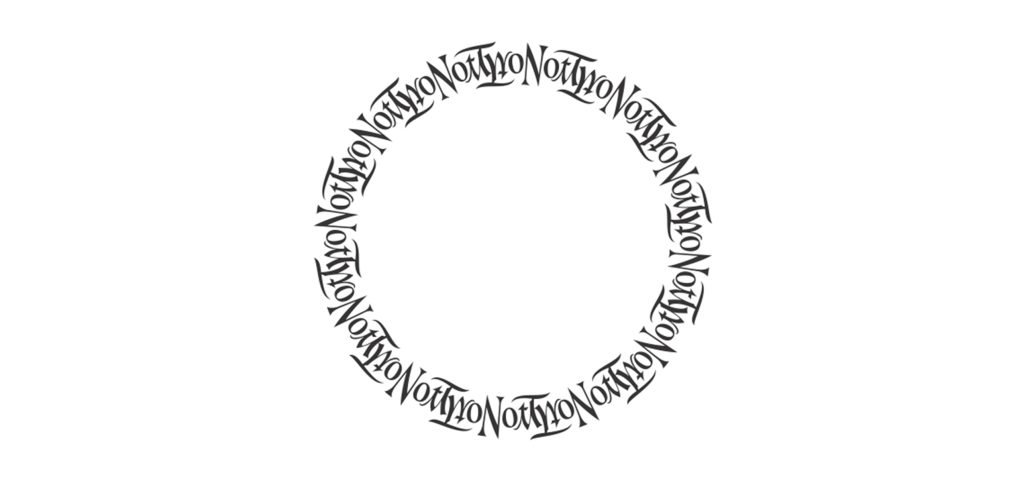
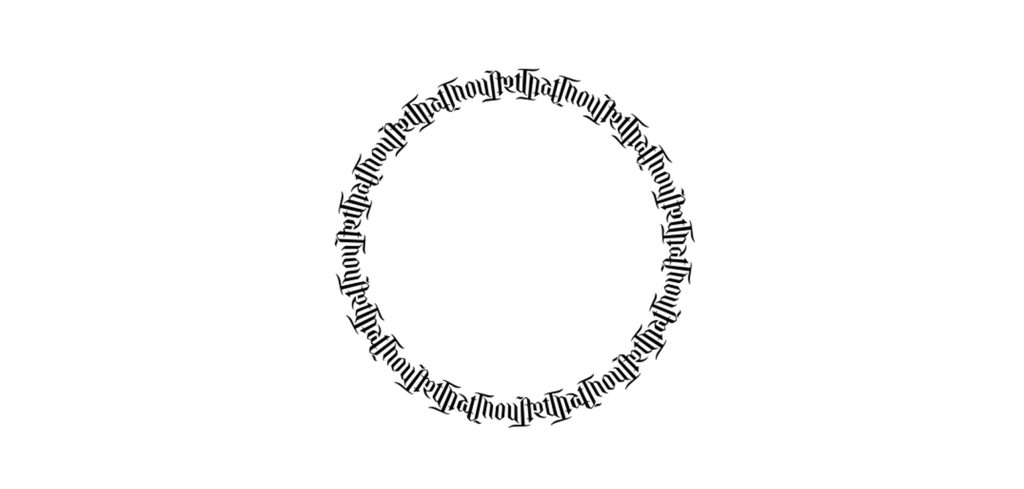

One. Not Two. That Thou Art. Tat Tvam Asi.
Around the same time I was designing the cover for Dennis Waite’s The Book of One, and we wanted an advertisement for it in the spiritual and yoga magazines. Dan Brown’s The Lost Symbol had just been released, with a great deal of noise around it. Being a lover of puns, I saw an opening.
So I wrote to John, carefully, asking permission to use his surname:
John,
I am in the process of thinking through an ad campaign for The Book of One. It will be primarily published in relevant magazines.
I was thinking of an audacious idea for your consideration. Please smile and indulge me. I have made a very crude version, basically to give you an idea. The headlines are what matter and require your permission.
Don’t chide me please.
He wrote back:
Kiran,
I like audacity in general, and I like yours a lot.
I would suggest that the headline read: “Professor Langdon has found a new symbol.”
I am, in fact, a full professor. While you and the copywriters cannot legally refer to Angels & Demons in promoting my part in your product, you may — in my non-lawyerly opinion — refer to Dan Brown’s most recent book and to the character Robert Langdon, and take advantage of the ambiguity inherent in your idea. But I think not using Robert or John is a good idea.
John
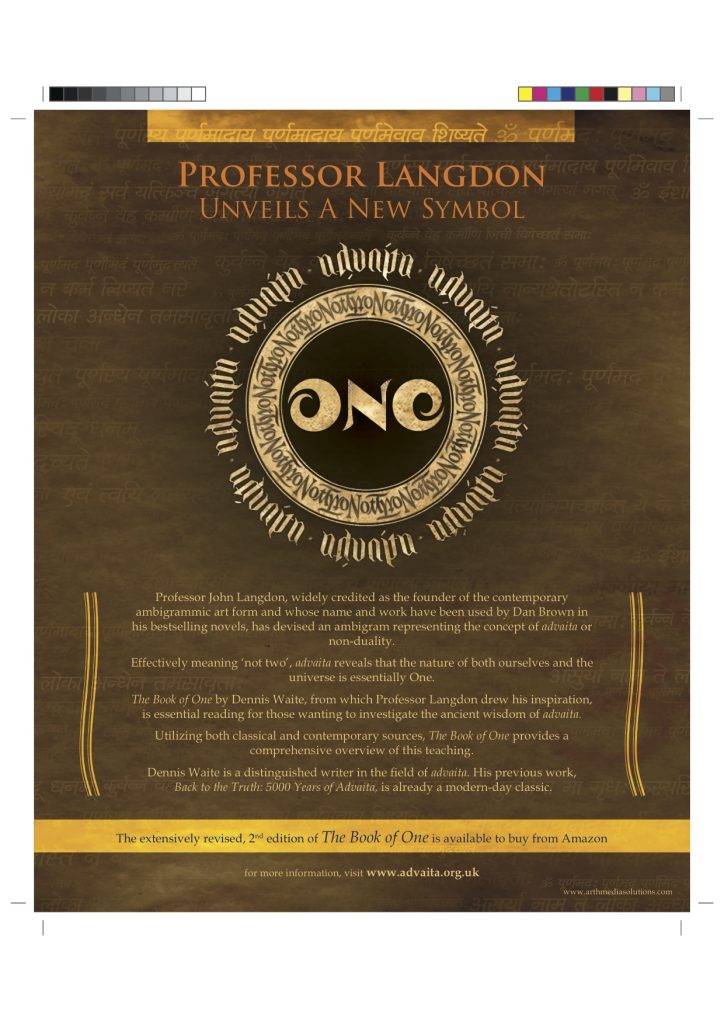
Looking back at those ambigrams now, I understand what I was doing better than I did at the time.
Every word I asked him to make was a word or a sentence from the śāstra. The pun did the same thing from the other side: say one thing, convey another, use the word to carry something deeper than itself. In choosing to represent these words graphically as unities, I was not only trying to convey their meaning to others. I was contemplating them, repeatedly, myself.
I had been commissioning śabda pramāṇa without recognising it. The chiselling of words to make them show what they mean is what made the importance of śabda land in me, slowly, over years — until the faith arrived that no argument had produced.
Thank you, John.
X. The Silence
A warning: this section is denser than the rest, and there are several ideas here that each deserve their own study. Read it when you have time, or read it twice.
Three absences, and what came out of them.
The absence of words
The first verse of the Dakṣiṇāmūrti Stotram, composed by Adi Shankara:
मौनव्याख्या प्रकटित परब्रह्मतत्त्वं युवानं वर्षिष्ठांते वसद् ऋषिगणौः आवृतं ब्रह्मनिष्ठैः । आचार्येन्द्रं करकलित चिन्मुद्रमानंदमूर्तिं स्वात्मारामं मुदितवदनं दक्षिणामूर्तिमीडे ॥१॥
Salutations to Sri Dakshinamurti, whose exposition through profound silence awakens the knowledge of the Supreme Brahman in the hearts of his disciples; who is himself youthful, and sits surrounded by old and great sages devoted to Brahman; whose hands form the cin-mudrā, and whose appearance is still and blissful; who rejoices in his own Self, which is reflected in his face.
Swami Tadatmananda Saraswati on the verse:
The ultimate reality is revealed through a silent exposition. What could silent teaching mean? Is it possible to express the reality of Brahman in one or two sentences? In one or two books? No amount of teaching is adequate to define what para brahma is. No number of words could ever define the reality we call Ishvara. Whatever words we use, Brahman is more than that. We truly have to admit that the reality is beyond words. There is a famous line in the Taittirīya Upaniṣad: the reality we seek is that from which words fall back, failing to grasp it. An exposition of silence is a poetic way of saying that the truth being conveyed is beyond the reach of language.
The idea of teaching in silence took hold of me and I went back to that verse again and again over several years. There was something in it I had not finished with.
The absence of sound
Dr Raja Angara, the sitar player, introduced me to John Cage’s 4′33″.
When I first heard it — or did not hear it — I was intrigued that a Western classical musician would perform a silent piece, and I went looking for what lay behind it. The best comment I found on it is this:
Although often described as a silent piece, 4′33″ isn’t silent at all. While the performer makes as little sound as possible, Cage breaks traditional boundaries by shifting attention from the stage to the audience and even beyond the concert hall. You soon become aware of a huge amount of sound, ranging from the mundane to the profound, from the expected to the surprising, from the intimate to the cosmic — shifting in seats, riffling programmes to see what in the world is going on, breathing, the air conditioning, a creaking door, passing traffic, an aeroplane, ringing in your ears, a recaptured memory. This is a deeply personal music, which each witness creates out of his or her own reactions to life. Concerts and records standardise our responses, but no two people will ever hear 4′33″ the same way. It is the ultimate sing-along: the audience, and the world, becomes the performer.
There is a detour worth taking here, because the usual account of this piece is wrong, or at least incomplete. Cage himself:
And then in the nick of time, Gita Sarabhai came from India. She was concerned about the influence Western music was having on traditional Indian music, and she’d decided to study Western music for six months with several teachers and then return to India to do what she could to preserve the Indian traditions. She studied contemporary music and counterpoint with me. She said, “How much do you charge?” I said, “It’ll be free if you’ll also teach me about Indian music.” We were together almost every day. At the end of six months, just before she flew away, she gave me the Gospel of Sri Ramakrishna. It took me a year to finish reading it.
And what she gave him, along with the book, was her teacher’s definition of the purpose of music: to quiet the mind and render it susceptible to divine influences.
4′33″ was composed in 1952. The point of it was to quieten the mind and make it receptive to ordinary sound, which he held could also be music. The encyclopaedias attribute the piece to Zen, and that is a subject for a different essay.
What I admire in Cage is not only the audacity of writing the piece but the conviction to have it performed with complete sincerity. This was 1952. The rebellion of the seventies would have absorbed it easily. How much time must he have spent persuading people that a silent piece was worth putting in front of an audience that could only laugh at it?
The absence of material
Coming back from Storm King in the autumn of 2013, I stopped at Dia Beacon.
I have been to a great many sculpture parks and shows, and I am used to the aha moment. Fred Sandback was the mother of all of them.
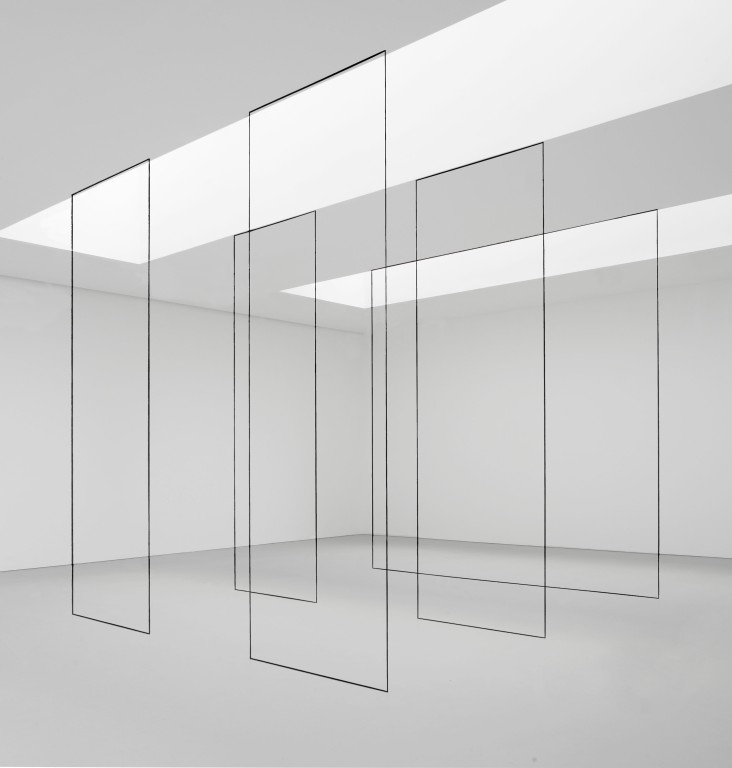
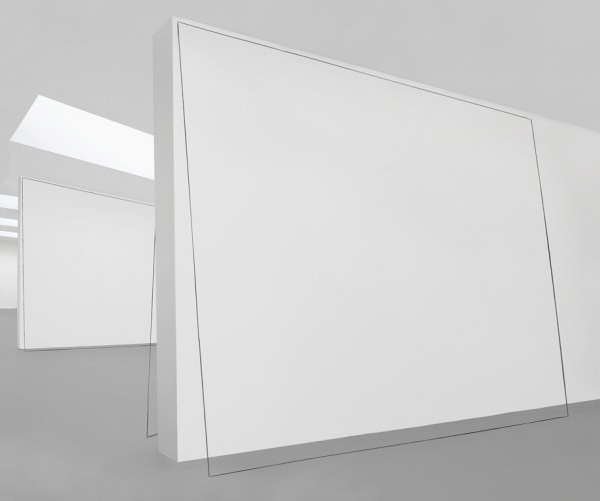
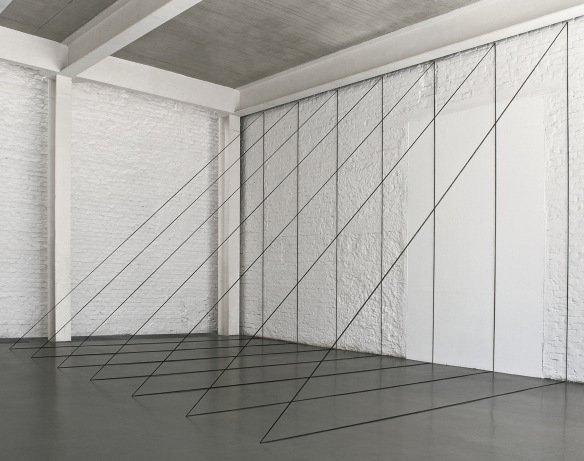
Using nothing but lengths of coloured yarn, Sandback made sculptures that envelope space — giving it a boundary and an edge while leaving it entirely open for you to imagine what the enclosed space might contain. Or you can take the whole gallery as the sculpture, with the strings strung through it in a pattern, so that the walls are the enclosure and you experience the outside and the inside of a space at once.
The artist, on how it began:
The first sculpture I made with a piece of string and a little wire was the outline of a rectangular solid lying on the floor. It was a casual act, but it seemed to open up a lot of possibilities for me.
Maybe some perverse intentions: I wanted to make something without an interior, at least in the sense of a conventional sculpture which has an invisible interior. I didn’t want a volume enclosed by a surface. I also wanted a wholeness that was, approximately, not reducible.
It described the edges of a rectangular solid on the floor, two inches high by four inches wide by twenty feet long. A lot of the early pieces had the quality of being the boundary of an object, more or less.
He wanted, in his own words, to assert a place or a volume in its full materiality without occupying and obscuring it.
I reacted to each piece individually, and I got it wrong. I kept imagining what material, what object, what colour would do justice to the space the strings enclosed. It was an exercise in collecting everything and putting back into the space precisely what the artist had so beautifully got rid of. I was injecting material into a space made by taking material away.
It was in the middle of doing that that I realised the beauty of the work was in the absence of the material. The simplicity with which those fragile lines carry it has stayed with me since.
Dia holds Serra, Judd, Kawara, Warhol. It is always difficult to weigh one against another. Sandback’s work took on a spiritual dimension that resonated more strongly with me than any of them, and I think it is because of where I come from.
What the three have in common
I kept returning to the first verse of the Dakṣiṇāmūrti Stotram. And I kept thinking about Sandback and about Cage. I could feel a connection between the three and could not name it.
Then it arrived. The common theme across all three is the absence of something.
The absence of words, to teach the truth. The absence of sound, to reveal the music in ordinary sound. The absence of material, to reveal the beauty of space — which we take entirely for granted.
Alongside this, my own wish to make something of my own was pressing harder. So I took absence into two other forms.
A film with almost no image
Imagine a ninety-minute film in which you spend sixty to seventy-five minutes looking at a black screen. The story moves through dialogue, sound and score alone.
Three possible lines:
One. Built on the Dṛg-Dṛśya-Viveka, which distinguishes consciousness — the absolute seer — from the mind, which is both seer and seen, and from the sense organs. Having heard his teacher, the student goes through mananam: limited glimpses of the external world interspersed with darkness, and visuals of his own thoughts and feelings, free of any limit of space or time, until the text opens for him.
Two. A man is poisoned, and instead of dying he goes temporarily blind. He escapes his killers and races to find an antidote before the blindness becomes permanent and they find him. The narration is his inner dialogue, his conversations with strangers, familiar sounds, and score. When he speaks to a stranger, one brief image places him.
Three. An explorer falls into a cave system — in Peru, or Cambodia — built in antiquity so that sunlight enters for five minutes a day, when the sun crosses one particular point. The rest of the day he lives in the dark and must find his way out.
Stop here and picture yourself sitting in a cinema for ninety minutes with fifteen to thirty minutes of image.
Without the visual, the film forces you to see the story through sound.
A work with no material at all
Imagine a yoga studio. People are lying in śavāsana, or sitting in a meditative posture. Someone is seated facing them.
The instructor is not a yoga teacher. He is an artist.
For the next thirty minutes he will describe his work — a painting, a sculpture, an installation. How much he describes is entirely his own choice. He may be vivid and exact or vague and cryptic. There is no set method. When he has finished he may discuss the work with the audience, or simply leave, leaving no trace of his art except in their memories.
No material used. No strings attached — to the ceiling or the floor.
Just words describing the work.
The description will be his. The visualisation will be theirs, and it will be different in every person in the room. No two of them will see the same thing.
Stop here and picture yourself sitting, in that posture, listening to an artist you love describe a work you will never see.
Both ideas came out of the same understanding, and any of us can take absence somewhere else. To adapt what Gita Sarabhai told Cage: absence quietens the mind and renders it susceptible to creative influences. Because in creativity, for me, there is divinity.
Coda: the one that was built
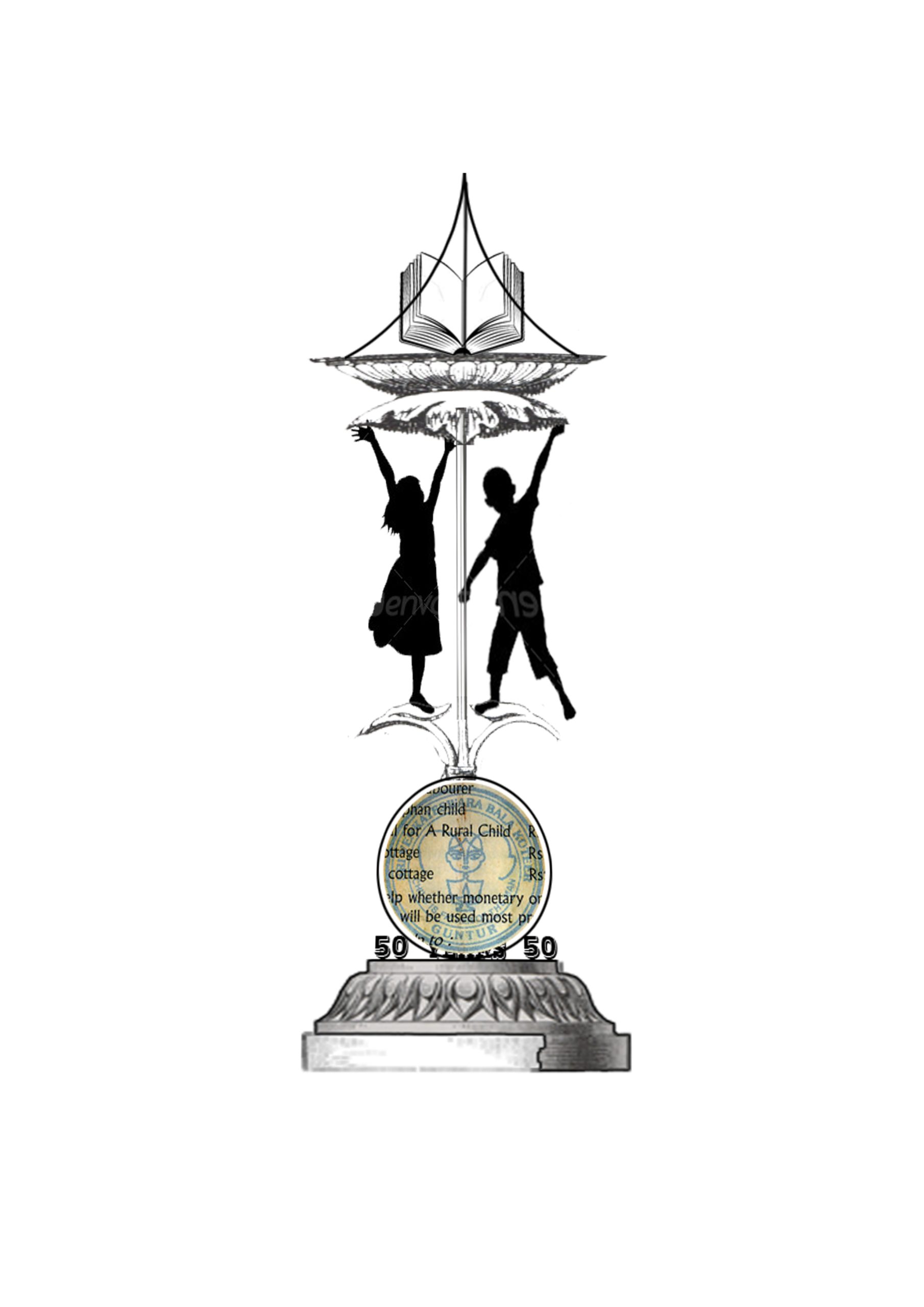
Everything in this essay is a reading. Nineteen encounters, nineteen concepts laid over them, and about half of them ending in a proposal for something that should exist. The film has not been made. The described-only exhibition has not been staged. The antigravity chamber, the two panels for Nolan, the corridor of mirrors, the memorial for N. T. Rama Rao — none of them exist.
There is one exception, and it is not in this essay because it is not a reading.
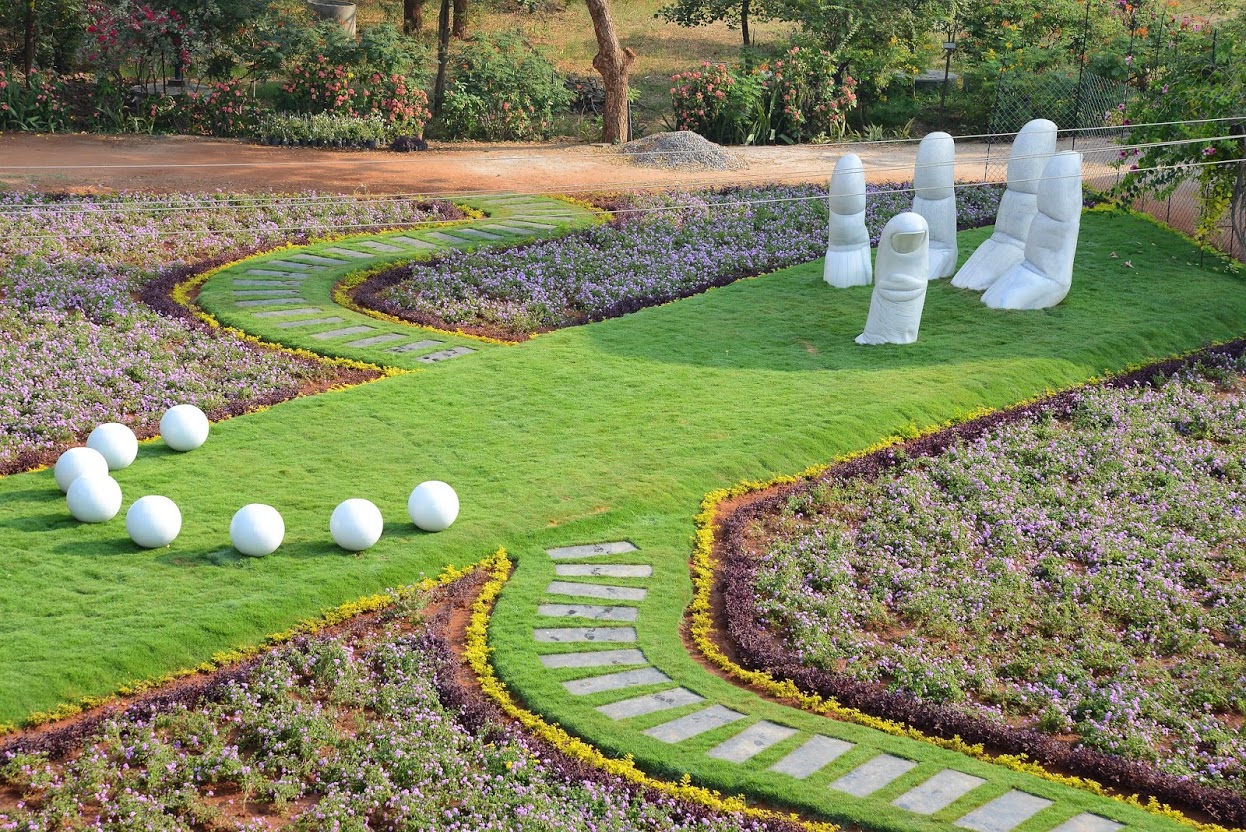
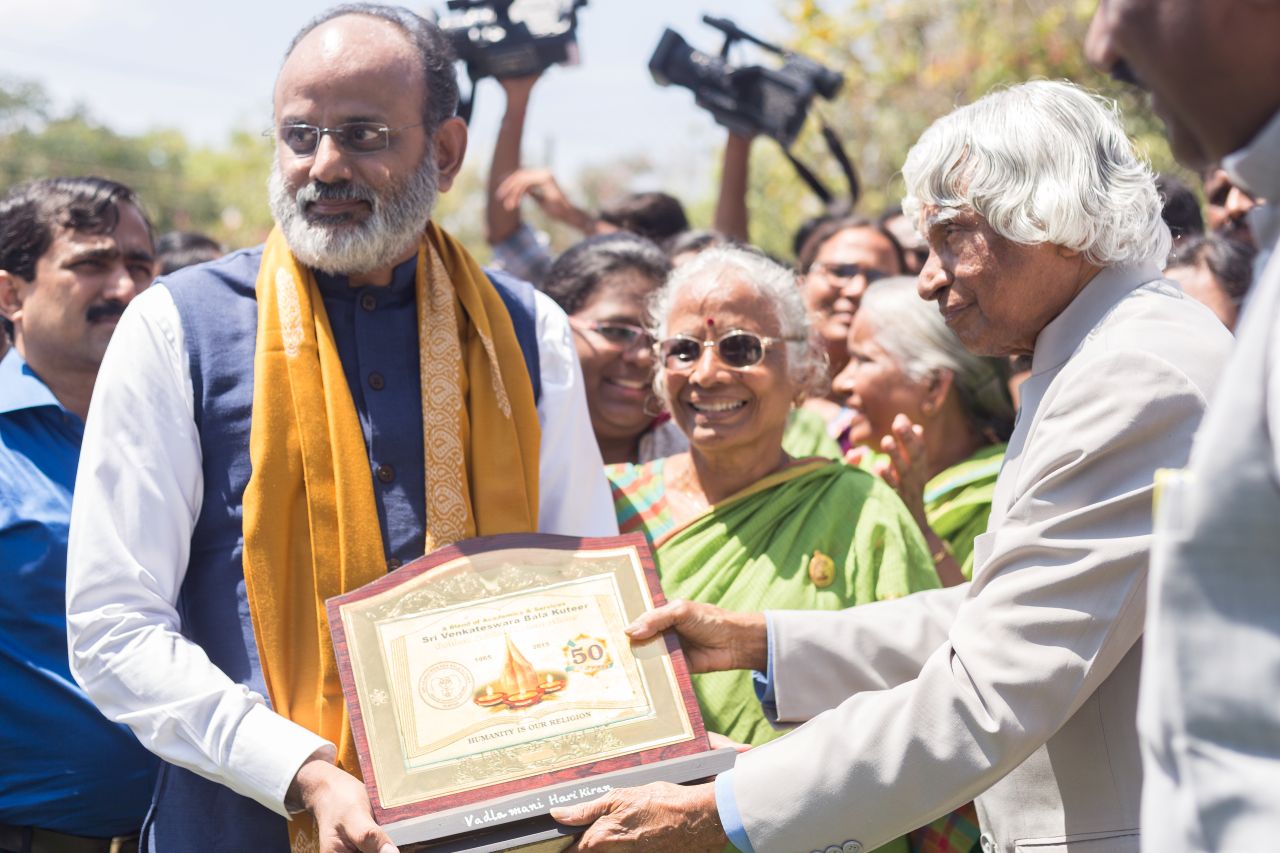
In 2015 the founder of my old school in Guntur, Miss Manga Devi, asked me to help with a sculpture for the school’s golden jubilee. I wrote back and said I would rather make something conceptual, and sent her an image I had come across on Twitter: Caring Hand, by Eva Oertli and Beat Huber. She liked it. I wrote to the artists in Switzerland for their permission to build on their idea, and engaged my friend the sculptor Y. Sivarama Chary to execute it.
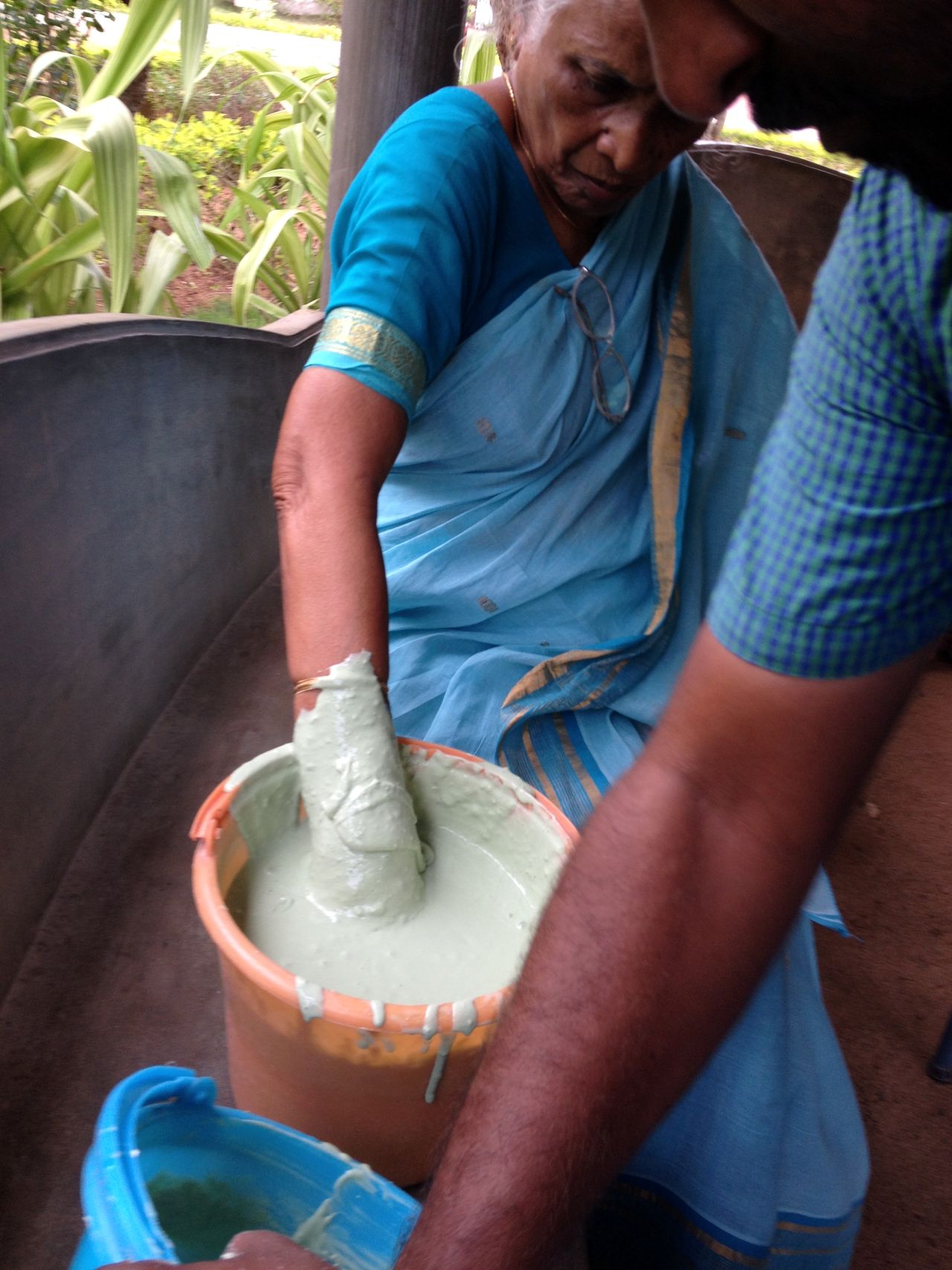
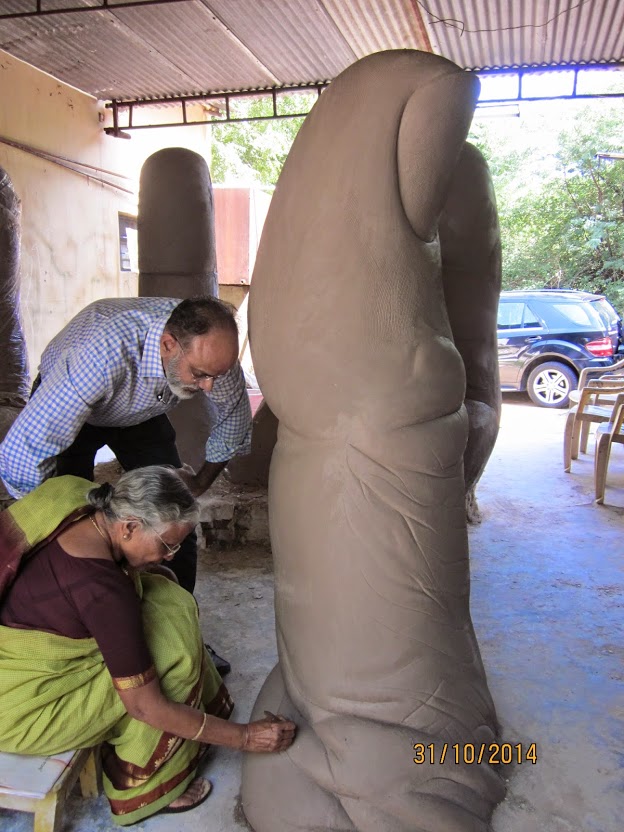
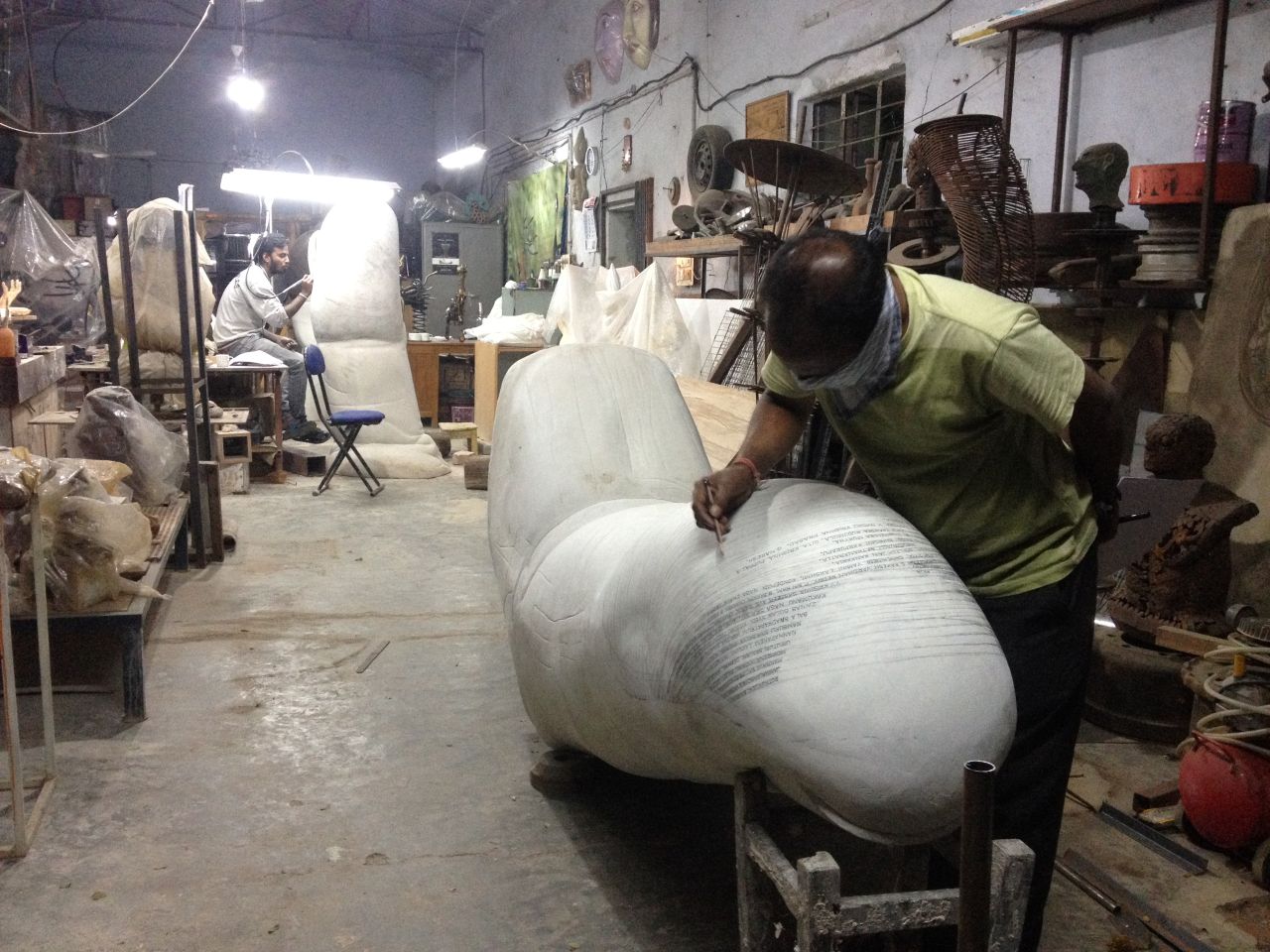
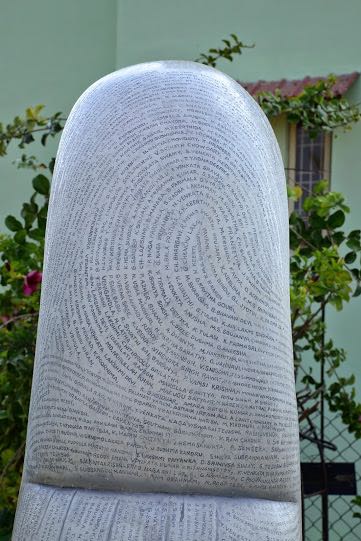
We took a cast of Miss Devi’s hands. Fifty steps run across the field, one for each year of the school, laid out like a reel of film so that a student can walk back through the years. Five and a half thousand flowers line the path, one for each student who has passed through. A strip of grass forms the classroom. Eight seats on one side stand for the first batch of 1965. On the other, five gigantic fingers rise out of the grass towards the sky — and when you walk up to them you find the names of every student engraved on them in the form of fingerprints, so that they have become as much a part of her as she has of them.
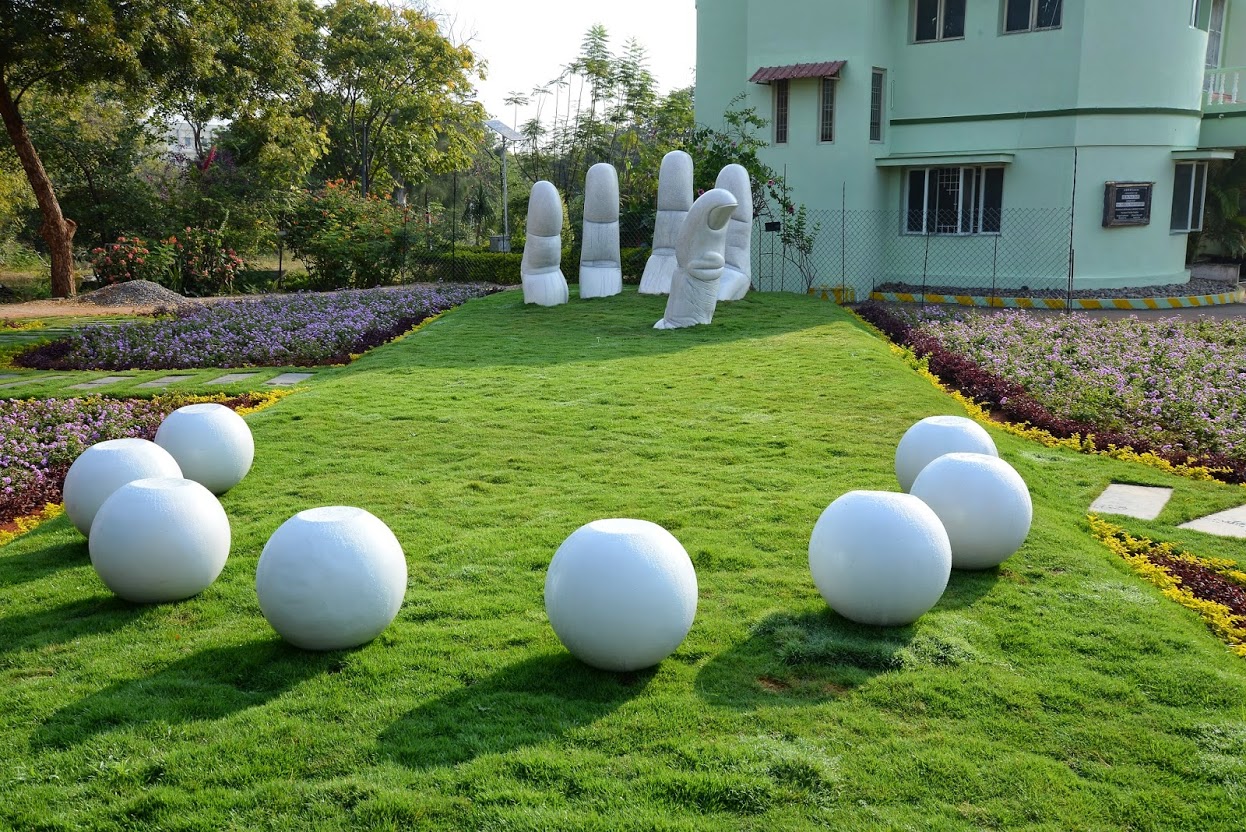
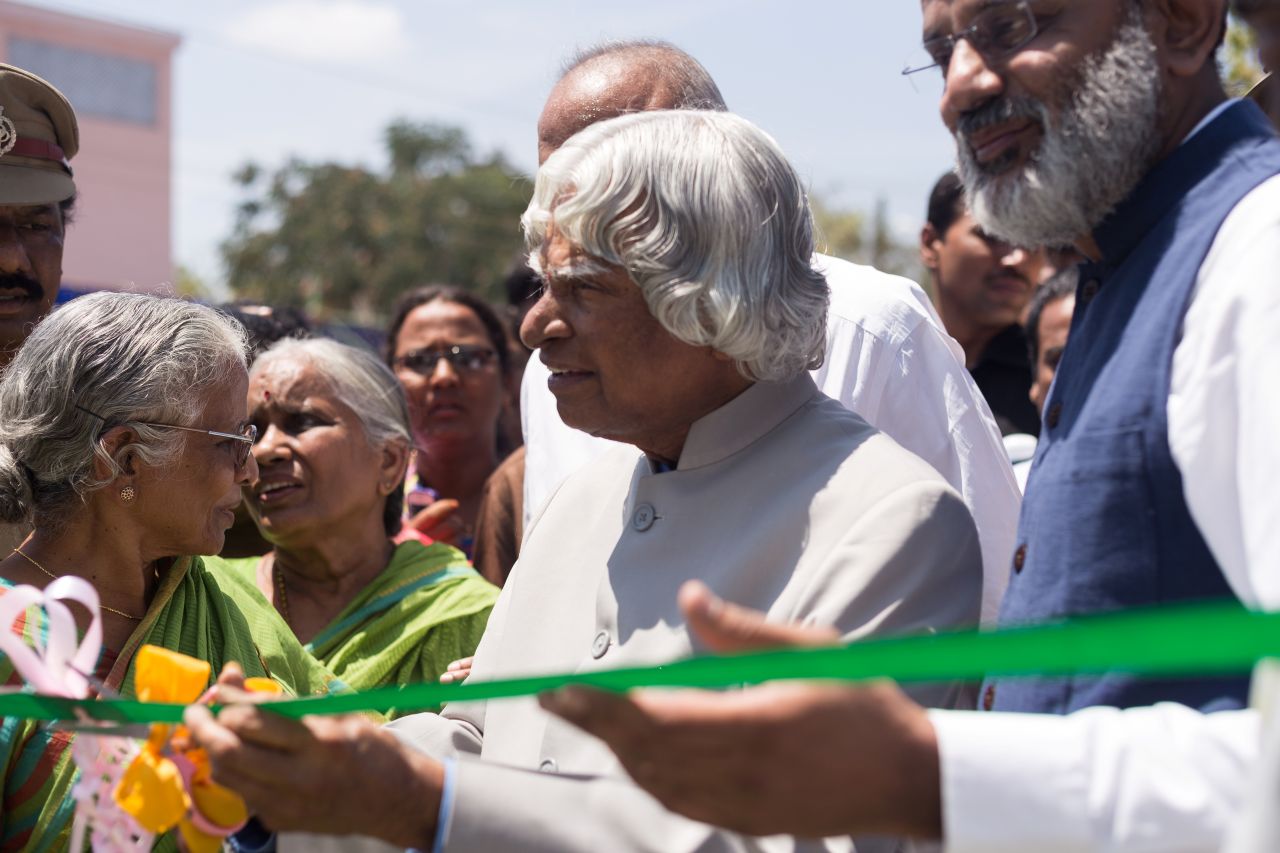
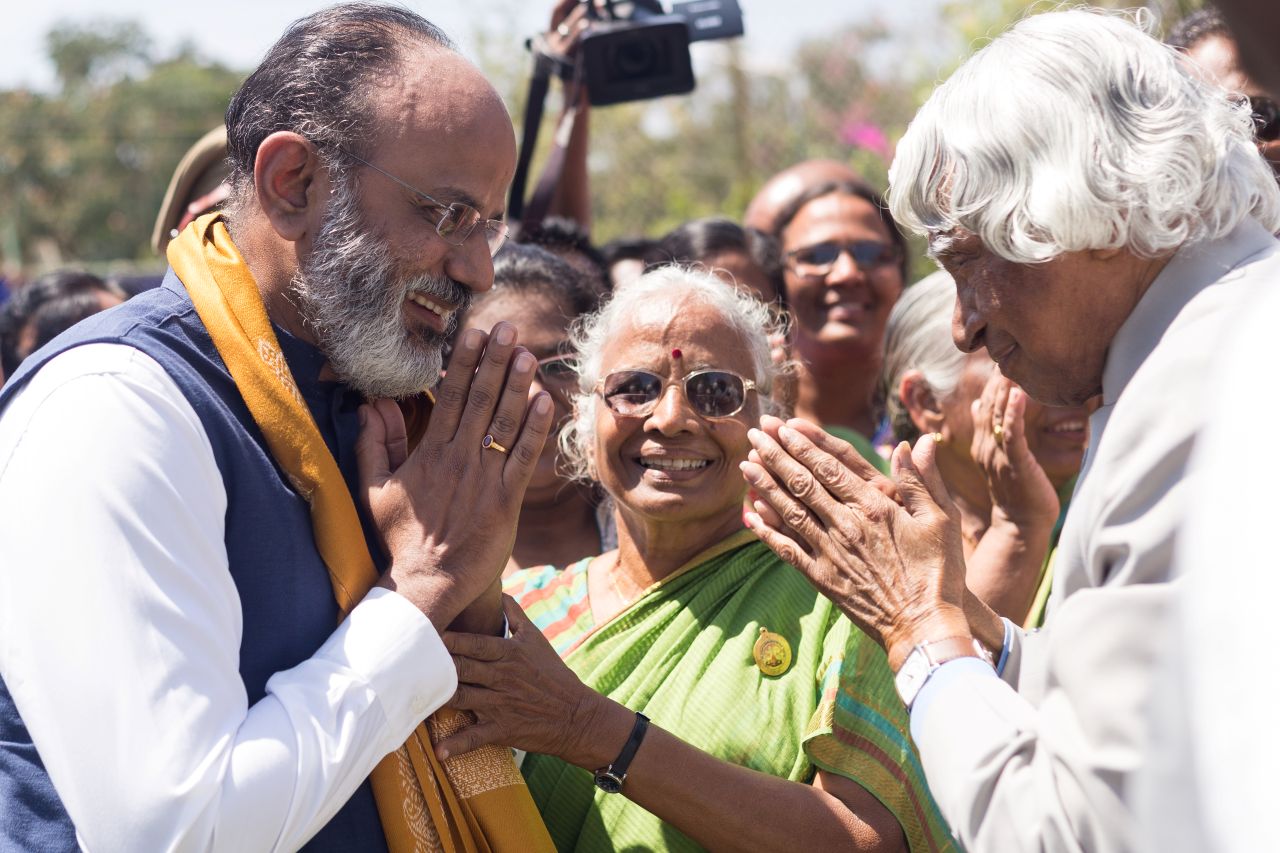
It was inaugurated by Abdul Kalam.
I mention it here for one reason. It is the only place in this entire body of work where the procedure was built rather than described — where the object is a device, sited so that a person must walk to it, and what it produces is a recollection that only they can see.
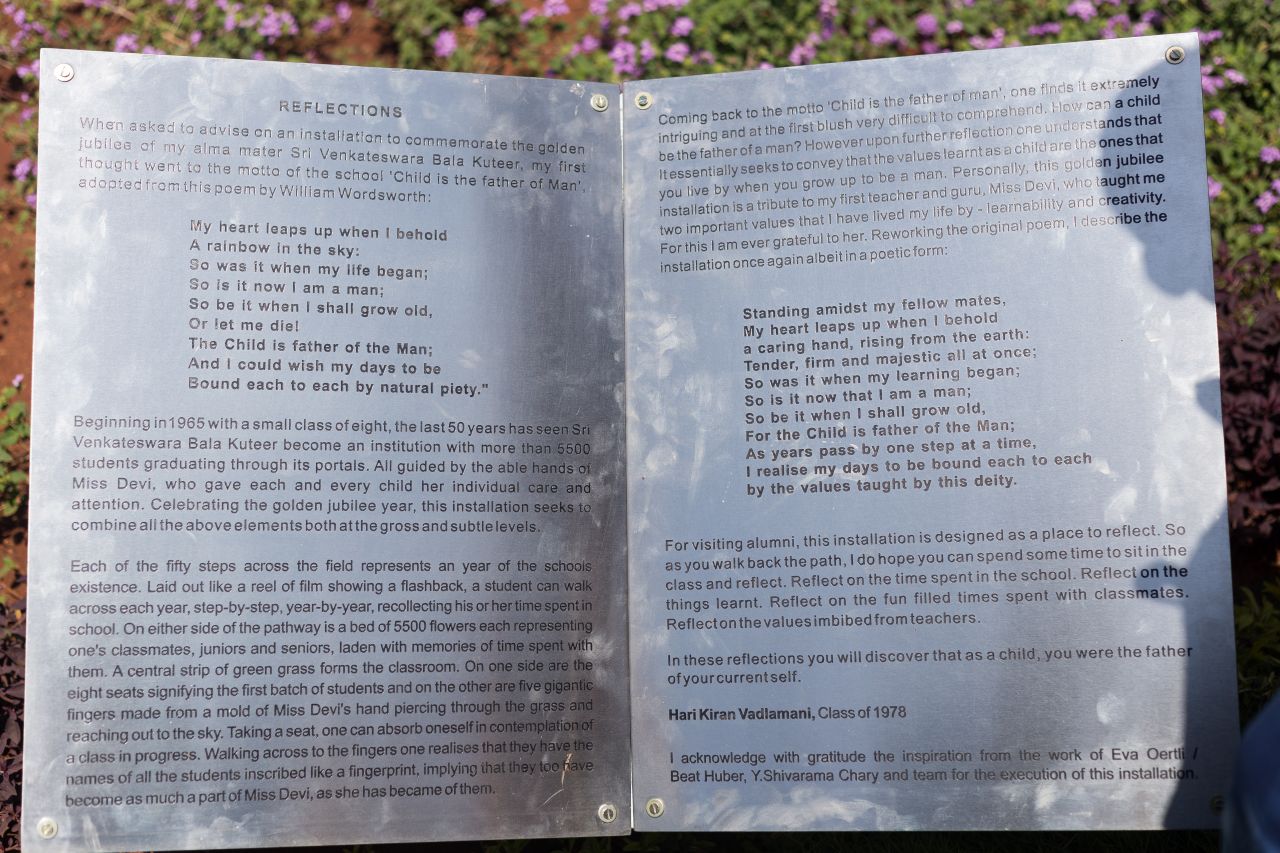
The essays are prakriyas in words. That one is a prakriya in stone.
I would like the ratio to change.
Om Tat Sat.